


But in the digital world, almost nothing works “for free.” If users are not paying for the product, it does not necessarily mean the product itself is free.
Recently, newage. CEO Oleksandr Rolskyi gave a lecture for teenagers as part of the Zminotvortsi initiative, explaining how the internet economy, digital advertising, and platform algorithms actually work. We decided to continue this conversation in the format of an article.
What Is the Internet Economy in Simple Terms
The internet economy is a system where companies, platforms, brands, and users interact through a digital environment. Simply put, it includes everything that helps generate revenue online: advertising, online stores, streaming services, social media, marketplaces, apps, and digital platforms.
The main “currencies” of today’s digital world are:
- attention — how much time users spend on a platform;
- data — what people search for, watch, like, or buy;
- advertising — the primary monetization model for most platforms.
That is why major digital platforms make most of their money not from users themselves, but from advertisers. Businesses pay platforms for access to audiences, while platforms use data and algorithms to show ads to the people most likely to be interested in them.
Who Participates in the Internet Economy
The internet economy is a massive system where users, platforms, brands, and advertising agencies interact simultaneously. Each of them plays a different role, but they are all connected through data, content, and advertising.
Users
At the center of the entire digital ecosystem are users. They create the internet’s most valuable resource — attention. Every day, people:
- watch videos;
- scroll through social media feeds;
- like content;
- search for information on Google;
- click on ads;
- buy products online.
Each of these actions leaves behind so-called behavioral signals. Platforms analyze what users are interested in, how much time they spend in an app, what content they interact with, and what might interest them next.
Platforms
Digital platforms collect and analyze massive amounts of user behavior data. Their algorithms take into account:
- interests;
- search queries;
- views;
- interactions with content;
- geolocation;
- activity time;
- even scrolling speed or video watch time.
Based on this data, platforms build content recommendations and advertising audiences that brands later use to promote their products.
Advertisers and Brands
Businesses come to digital platforms for one thing — audience attention. Companies run ads to:
- sell products;
- find new customers;
- increase brand awareness;
- bring users back to their websites or apps.
In practice, brands constantly compete for a place in users’ feeds, as well as for their time and attention. That is why digital advertising has become so highly personalized today.
Advertising Agencies
Advertising agencies help brands work effectively with platforms and data. Their main responsibilities include:
- planning advertising campaigns;
- audience analysis;
- creative production;
- ad setup and management;
- campaign optimization;
- analytics and performance measurement.
Agencies often act as the “bridge” between platforms, algorithms, and businesses, helping brands use digital tools more effectively.

How the Advertising Auction Works
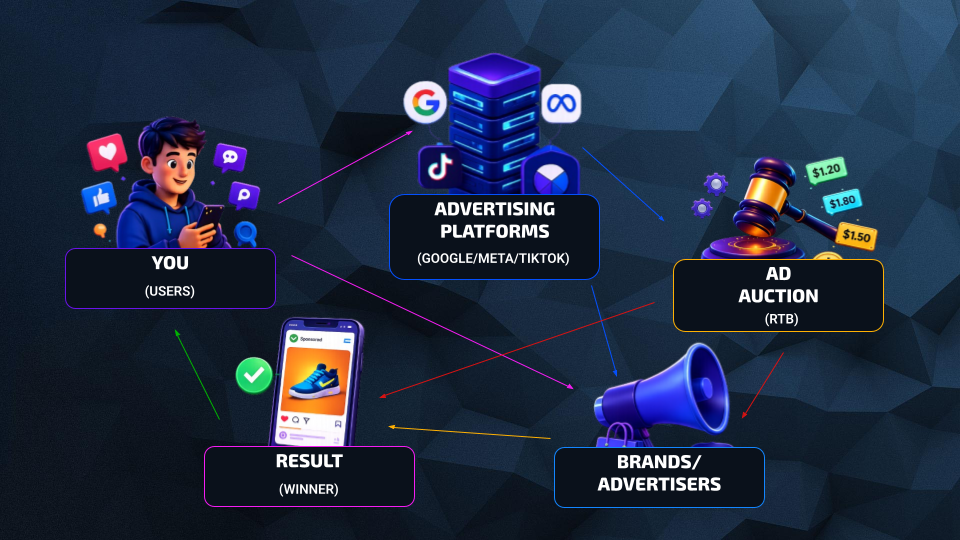
Every time a user opens a website, YouTube, Instagram, or TikTok, an advertising auction is launched almost instantly in the background. The platform analyzes who opened the app, what the user is interested in, and which brands may want to show ads to that specific audience.
At that moment, several advertisers simultaneously “compete” for the opportunity to display their ad to a particular user. The system considers not only the advertiser’s bid, but also the relevance of the ad, the likelihood of engagement, and the user’s previous behavior.
This process is called RTB (Real-Time Bidding) — a real-time advertising auction. Everything happens within milliseconds, so users do not even notice that an entire digital auction for their attention has already taken place while opening a feed or video.
Why You See Certain Ads
Many users have noticed a strange coincidence at least once: you search for a new phone, talk about a trip, or watch a few sports videos — and suddenly ads related to those topics start “following” you across social media and websites. In reality, this is the result of platform algorithms and targeting systems at work.
For example, if someone regularly watches gaming content, follows esports channels, and searches for new PC components, algorithms may classify them as a “gamer” or “tech enthusiast.” As a result, that person is more likely to see ads for games, gadgets, or tech accessories.
Retargeting also plays a major role. If a user has already visited a brand’s website, added a product to their cart, or viewed a specific item, the system may continue showing ads for that product across other platforms.
In addition, platforms use look-alike and predictive algorithms — systems that search for people with similar behavior patterns and predict which content or ads are most likely to interest a particular user.
Advantages and Risks of the Internet Economy
The internet economy has completely transformed the way people consume content, communicate, shop, and build businesses. At the same time, along with new opportunities, new challenges have also emerged.
Advantages of the Internet Economy
- Free Services
The advertising model has made most modern platforms free for everyday users. YouTube, Google Maps, Instagram, TikTok, Gmail, and Facebook do not require direct payment because they are funded through advertising.
- Personalization
Algorithms and analytics help platforms better understand user interests. As a result, people receive:
- more relevant content;
- personalized recommendations;
- more convenient search results;
- ads that may actually be useful to them.
Personalization has become one of the key reasons behind the popularity of TikTok and YouTube Shorts.
- Accessibility for Small Businesses
Digital advertising has significantly lowered the barrier to entry for businesses. While TV commercials and outdoor advertising once required massive budgets, today even small brands can launch campaigns through Google or Meta and reach their target audience.
Risks of the Internet Economy
- Data Privacy
One of the biggest discussions in today’s digital world revolves around the collection and use of personal data. Many users do not fully realize how much information platforms analyze about their behavior.
- Filter Bubbles
Algorithms are designed to show users content they are most likely to enjoy. As a result, people often see only content that reinforces their existing interests and opinions.
- Advertising Overload
Competition for attention means users are exposed to a huge amount of advertising every day. Social media feeds, videos, websites, and apps are constantly trying to capture and удержать user attention.
Understanding how the internet economy works helps brands communicate more effectively with digital audiences and advertising platforms. This is exactly how newage. helps businesses navigate today’s digital ecosystem — from analytics and media strategy to AI solutions and advertising technologies.
FAQ: Internet Economy Explained
Why are internet services free?
Most platforms do not make money directly from users, but from advertising. Businesses pay Google, YouTube, Instagram, TikTok, and other services for access to audiences, while users effectively “pay” with their attention and data.
What is an advertising auction?
An advertising auction is an automated process in which brands compete within milliseconds for the opportunity to show an ad to a specific user. The platform considers the advertiser’s bid, ad quality, and audience relevance.
What data do digital platforms collect?
Platforms may analyze search queries, video views, likes, clicks, geolocation, activity time, content interactions, and other behavioral signals to better personalize ads and recommendations.
Why do TikTok and YouTube recommend content so accurately?
Recommendation algorithms analyze user behavior and predict which content is most likely to keep a person engaged. That is why TikTok, YouTube, and Instagram feeds become increasingly personalized over time.
How is AI changing the internet economy?
AI is transforming advertising, content creation, recommendation systems, and analytics. Modern algorithms can already optimize campaigns automatically, predict user behavior, and personalize digital experiences almost in real time.