


September 18, 2026
Data quality is the foundation of effective digital analytics. To accurately assess the contribution of advertising channels, businesses need to track user actions on their websites and understand where users come from and which channel drove each session.
How We Reduced the Share of Direct Traffic from 80% to 48% with Server-Side Tracking
September 18, 2026
Data quality is the foundation of effective digital analytics. To accurately assess the contribution of advertising channels, businesses need to track user actions on their websites and understand where users come from and which channel drove each session.
Svitlana Kryskova
However, traditional client-side tracking is increasingly affected by browser restrictions and evolving privacy standards. As a result, some data may be transmitted incompletely or attributed incorrectly, affecting the overall picture of marketing performance.
In this case study, we explain how we implemented server-side tracking and how the traffic distribution in Google Analytics 4 changed after the implementation.
The Challenge: 80% of Sessions Were Attributed to Direct
Before implementing server-side tracking, around 80% of all Calista sessions in Google Analytics 4 were attributed to Direct. Such a high share made it difficult to understand which channels were actually driving users to the website.
Direct itself is a normal part of the traffic mix. It can include, for example, users who enter the website address directly or arrive from sources for which GA4 cannot identify a referrer or other source information. The problem arises when Direct accounts for a significant share of sessions whose actual source the analytics system could not properly identify.
For Calista, this meant there was insufficient data to accurately assess the contribution of individual advertising channels, particularly Display and Paid Search. When a session source is not identified correctly, businesses get an incomplete view of the customer journey, making it more difficult to compare channel performance and make informed advertising decisions.
Another factor is that traditional client-side tracking depends on the user’s browser. Browser restrictions and privacy mechanisms can limit cookie functionality and the transmission of certain data, making this tracking architecture less reliable.
Therefore, the goal was not simply to reduce the share of Direct traffic in the reports, but to build a more controlled first-party data collection architecture and improve the quality of analytics and attribution for Calista.
What Is Server-Side Tracking?
Server-side tracking is an approach to data collection and transmission in which part of the processing of data about users’ interactions with a website is moved from the browser to a server environment.
With traditional client-side tracking, analytics and advertising tags run directly in the user’s browser and send data to the relevant platforms. This process largely depends on the browser, cookies, and the user’s privacy settings.
Importantly, server-side tracking does not bypass privacy requirements or user consent. Instead, it changes the technical architecture of how data is handled and helps businesses build a more controlled first-party data environment.
The Solution: Server-Side Tracking with Google Cloud Run
To improve data collection and attribution quality, the newage. team implemented server-side tracking for Calista using Google Cloud Run.
As part of the new architecture, we moved data transmission to Google Analytics 4 and Floodlight to the server and also set up first-party tracking.
Importantly, during this period, there were no other major changes to the advertising campaigns or analytics setup. This allowed us to separately analyze how the data structure and the distribution of sessions across channels changed after the implementation.
At the same time, we do not attribute every change in performance metrics solely to server-side tracking. Traffic volume and distribution can also be affected by campaign activity, budgets, seasonality, and user behavior. Therefore, our analysis focuses primarily on how traffic attribution across channels changed after the implementation.
How Attribution Changed After the Implementation
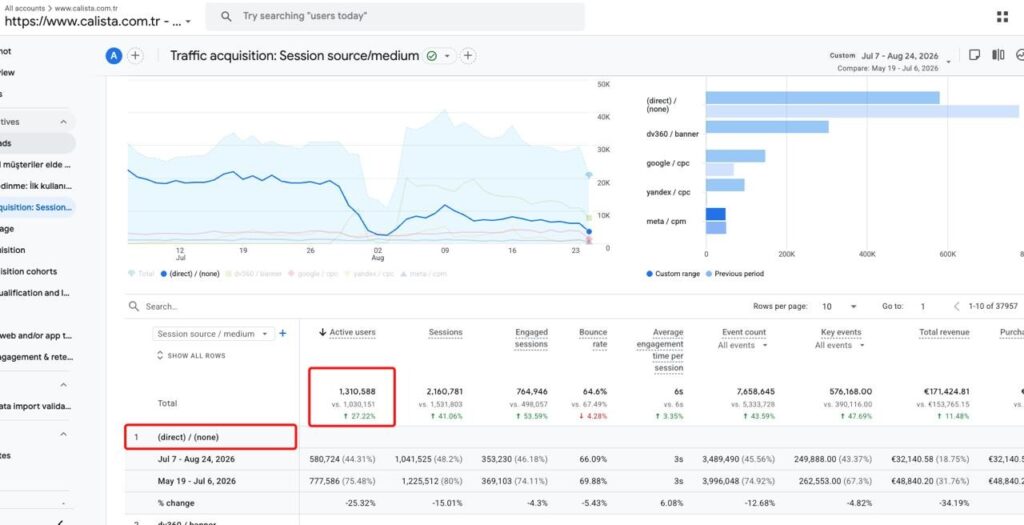
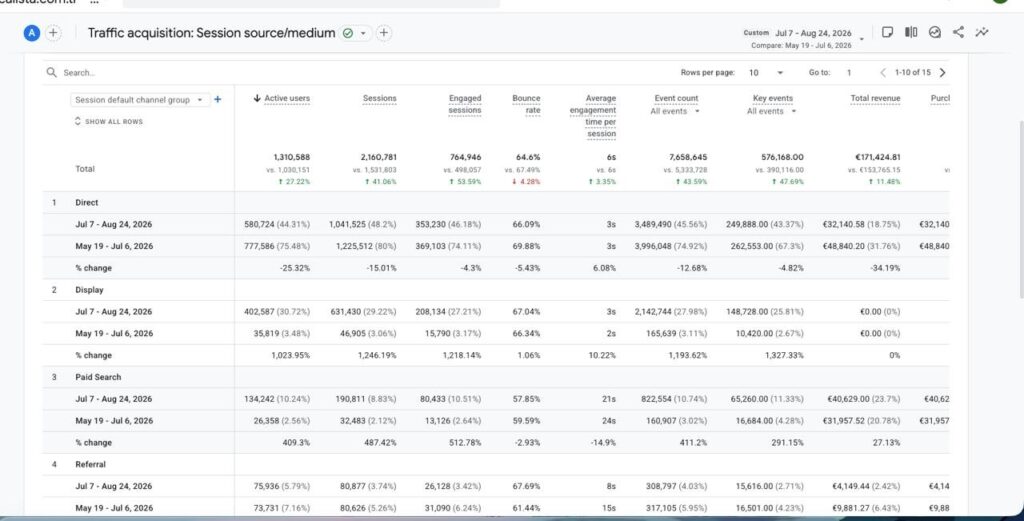
To evaluate the changes after launching server-side tracking, we compared Google Analytics 4 data for July 7–August 24, 2026 with the previous period of the same length — May 19–July 6, 2026.
After the implementation, the traffic distribution changed significantly. The share of Direct, which had previously dominated the analytics data, decreased substantially, while a larger share of sessions began to be attributed to Display and Paid Search.
| Channel | Before Implementation | After Implementation |
| Direct | ~80% | ~48% |
| Display | ~3% | ~29% |
| Paid Search | ~2% | ~9% |
At the same time, the total number of sessions recorded in GA4 during the compared periods increased by approximately 41%.
These figures do not mean that all changes in traffic volume were caused solely by the transition to server-side tracking. They may also have been influenced by campaign activity, budgets, seasonality, and other factors. For this case study, the key finding is the change in the attribution structure — GA4 began to show a significantly more detailed distribution of sessions across marketing channels.
Direct: From 80% to 48%
Before the implementation of server-side tracking, around 1.23 million sessions were attributed to Direct, accounting for approximately 80% of all traffic. After the implementation, the number of Direct sessions decreased to around 1.04 million, while their share fell to 48%.
In absolute terms, Direct sessions decreased by approximately 15%. However, the more significant change was in Direct’s share of the overall traffic mix, which dropped by nearly 32 percentage points. In other words, after the implementation, Direct no longer dominated the analytics data to the same extent as before.
Display: From 3% to 29%
The most significant change was seen in Display. Before the implementation, this channel accounted for around 46.9 thousand sessions, or just 3% of the total. In the following period, GA4 recorded approximately 631.4 thousand Display sessions, with the channel’s share increasing to around 29%.
In this case, the key point is not the increase in sessions itself, but rather that after the tracking architecture was changed, GA4 began attributing a significantly larger share of sessions to Display.
Paid Search: From 2% to 9%
A similar trend can be seen in Paid Search. The number of recorded sessions increased from approximately 32.5 thousand to 190.8 thousand, while the channel’s share of total traffic grew from 2% to 9%.
What This Meant for Calista
The main outcome of implementing server-side tracking for Calista was improved data quality for analyzing marketing channels. After moving to the new architecture, the traffic distribution in GA4 became significantly more detailed: instead of being dominated by Direct, a larger share of sessions was attributed to specific channels.
This gave Calista a clearer view of the customer journey and more data to assess the role of Display, Paid Search, and other traffic sources. As a result, the team can better understand which advertising activities drive users to the website and how they contribute to overall performance.
Higher-quality attribution also provides a more reliable foundation for media decisions — from comparing channels and analyzing campaign performance to making informed decisions about further media investment optimization.
Why Server-Side Tracking Matters for Modern Analytics
Browser restrictions, cookie limitations, and the use of ad blockers are gradually changing the requirements for tracking infrastructure. For advertisers, it is becoming increasingly important not only to collect the necessary events but also to have greater control over how data is transmitted and processed.
One part of this shift is the development of first-party data infrastructure. Server-side tracking allows businesses to use their own server environment as part of the data collection system and reduce their dependence on certain browser-side limitations.
At the same time, server-side tracking does not eliminate the need for user consent and data protection, nor does it automatically guarantee complete attribution. Its value lies in creating a more controlled and resilient tracking architecture that provides a more reliable foundation for analytics and measurement.
From Data to Better Marketing Decisions
Data is valuable when it can be relied on to make informed decisions. That is why analytics goes beyond setting up tags and reports — it also requires a reliable infrastructure for collecting and transmitting data.
For Calista, the transition to server-side tracking was a step toward building this infrastructure and created a stronger foundation for further analytics and evaluation of advertising activities.
The newage. team helps businesses build and improve their measurement infrastructure — from setting up GA4 and Floodlight to server-side and first-party tracking. If you want to assess the quality of your current tracking setup or improve the data you use to make marketing decisions, contact us.


Get deeper into digital!
Subscribe to the newage. digital digest and receive exclusive bonus content