

June 3, 2026
A few years ago, Google was a fairly straightforward tool: you entered a query and received a list of links. While the algorithms became more sophisticated and the results more accurate over time, the underlying logic remained largely unchanged for decades. Google’s job was to find relevant pages, while users had to visit those pages to find the answers they were looking for.
Google AI Mode: How the New Search Experience Works
June 3, 2026
A few years ago, Google was a fairly straightforward tool: you entered a query and received a list of links. While the algorithms became more sophisticated and the results more accurate over time, the underlying logic remained largely unchanged for decades. Google’s job was to find relevant pages, while users had to visit those pages to find the answers they were looking for.
Svitlana Kryskova
Today, that model is beginning to change. With the introduction of AI Mode, Google is gradually moving away from being a traditional search engine. Instead of simply directing users to other websites, it now generates answers on its own.
What Is Google AI Mode?
Google AI Mode is a new search experience where the system does more than simply find pages matching a query — it generates an answer by combining information from multiple sources. Instead of a traditional list of search results, users receive an AI-generated response that brings together insights, explanations, and recommendations in a single view.
As a result, users no longer need to open dozens of tabs to piece together the information they need — Google does it for them.
It is important not to confuse AI Mode with AI Overviews, even though they may appear similar at first glance. AI Overviews is an AI-generated summary that appears above traditional search results and supplements them with a concise answer. However, the core SERP experience remains unchanged: users still see a list of websites and are expected to click through to find more information.
AI Mode works differently. Here, the answer becomes the center of the experience, while the traditional search results either move into the background or disappear altogether. Search becomes conversational: users can refine their queries, ask follow-up questions, and receive new answers within the same context.
This is why AI Mode should be viewed as a fundamental shift in search architecture. Google is no longer simply ranking web pages—it is interpreting information, synthesizing insights from multiple sources, and delivering them as a unified response.
How AI Mode Works
To understand how AI Mode differs from traditional search, it is important to look not only at the interface, but also at what happens “under the hood.” In practice, this is not a single algorithm, but a chain of processes: from analyzing the query to generating the final answer.
Let’s break it down step by step.
1. Query Understanding
In traditional search, keywords played the central role. Google looked for pages containing those keywords and ranked them based on relevance.
In AI Mode, the focus shifts from keywords to intent. The system analyzes not only the words themselves but also the context behind the query, trying to understand what the user actually wants: an explanation, a step-by-step guide, a comparison, or a recommendation.
This is especially important for complex or long-tail queries that were historically more difficult to process. For example, a query such as “which laptop is best for design and video editing under $1,500” is no longer treated as a collection of separate keywords. Instead, it is interpreted as a complete task that needs to be solved.
2. Query fan-out
Once Google understands the user’s intent, it does not search for a direct answer right away. Instead, the AI breaks the query down into multiple sub-queries.
This process is known as query fan-out. For example, the laptop query mentioned above might be automatically divided into several smaller questions:
- Which laptop models are suitable for design work?
- What specifications are important for video editing?
- Which options are available within the specified budget?
Each of these sub-queries is processed independently, allowing Google to gather more relevant information and generate a more accurate and comprehensive answer.
3. Search and Answer Generation
The next step is where the real magic happens: the combination of traditional search and generative AI.
Google uses its search index—the familiar search engine we know today—to find relevant information, while its Gemini model processes and synthesizes that information. Rather than simply copying text snippets from different sources, Gemini summarizes them, removes duplication, organizes key insights, and generates a unified response.
As a result, users receive more than just a list of sources. They get a structured, easy-to-understand answer that may include explanations, recommendations, comparisons, or even actionable next steps.
4. Follow-Up Logic
Another major change is the ability to continue the interaction.
In traditional Google Search, every query was treated as a separate request. With AI Mode, search becomes conversational. The system remembers the context of previous queries, allowing users to ask follow-up questions without having to start over.
For example, after searching for laptops, a user can simply ask, “Which of these is best for working while traveling?” and Google will provide an answer based on the context of the previous conversation. This creates a more natural and seamless search experience, similar to interacting with an AI assistant rather than a traditional search engine.
5. Multimodal Search
AI Mode is not limited to text-based queries. It is gradually integrating multiple ways of interacting with search, including voice, images, and, in some cases, even video.
For example, users can upload a photo of an object and ask questions about it, or continue their search using voice commands. The system processes these inputs alongside text, combining all available signals to generate a more relevant and contextual response.
This moves search even further away from the traditional keyword-based model and closer to the experience of interacting with a universal AI assistant.
What Search Looks Like in AI Mode
To understand the real impact of AI Mode, theory alone is not enough. The best way to see the difference is in practice—by looking at how the search process changes and what users actually receive in response.
Let’s consider a typical scenario.
Example Query
Imagine a user enters the following search query:
“Which smartphone should I choose in 2026 under $800 for photography and video?”
In traditional Google Search, the user would typically see:
- Articles and buying guides
- Product reviews
- Smartphone rankings and comparison lists
- YouTube videos and reviews
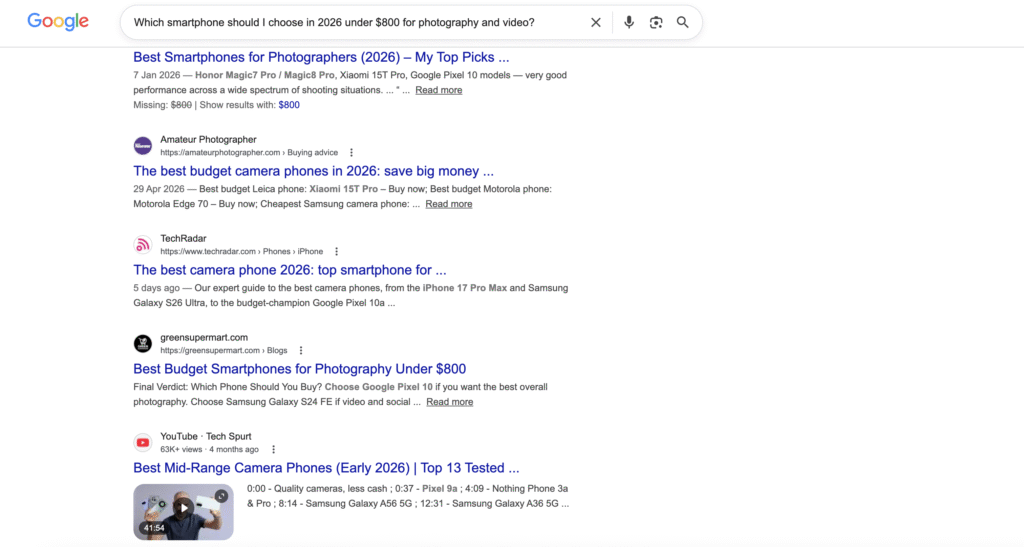
The user would then have to open several of these sources, compare information, and draw their own conclusions.
What an AI Mode Response Looks Like
With AI Mode, users receive a ready-made answer immediately. Instead of a list of links, Google generates a structured response that typically includes:
- A brief explanation or introduction
- A list of recommended models
- Comparisons highlighting key pros and cons
- Recommendations tailored to specific use cases
In effect, Google generates a “mini-article” directly within the search results. It already includes conclusions and recommendations that users previously had to piece together on their own.
What makes this even more powerful is that the response is not static. Users can refine it by asking follow-up questions such as, “Which option is best for night photography?” or “Are there any more affordable alternatives?” The system then continues the conversation and generates a new answer while retaining the context of the previous interaction.
What Happens to Links?
Links are not going away, but their role is changing dramatically.
In traditional search, links were Google’s primary product. They were what directed users to websites. In AI Mode, they become a supporting element:
- displayed as sources
- presented as cards or content snippets
- sometimes integrated directly into the generated response
The key difference is that users have already received an answer before clicking. Visiting a website is no longer a necessary step in the search journey.
What Does This Mean in Practice?
User behavior is fundamentally changing:
- users open fewer websites
- they reach decisions faster
- they interact more with Google itself rather than individual websites
For businesses and SEO professionals, this means one important thing: your content may be used to generate an answer, but the user may never actually visit your website.
What Changes for Users
AI Mode changes not only the search results page itself, but also user behavior. In the past, search was a series of separate actions: entering a query, reviewing results, opening multiple websites, and comparing information. Now, much of that process is condensed into a single interaction with Google.
At the same time, the way people formulate queries is changing. Users are relying less on short keyword phrases and increasingly using natural language, as if they were speaking to an assistant rather than a search engine. Queries are becoming longer, more specific, and more contextual, while search itself is becoming more conversational.
As a result, Google is no longer just a gateway to websites. It is becoming an environment where users receive a ready-made, processed answer immediately. This saves time, simplifies decision-making, and creates a new habit: instead of gathering information from multiple sources, users expect Google to consolidate and explain it for them.
And this is where the biggest change begins for brands, publishers, and businesses. If users no longer need to visit a website to get a basic answer, the traditional model of organic traffic starts to work differently. As a result, the logic of SEO changes as well.
How AI Mode Is Changing SEO
AI Mode is not just changing the search interface—it is changing the very logic of SEO. Practices that served as the foundation of search optimization for years are gradually becoming less effective or, in some cases, losing relevance altogether.
The reason is simple: if users no longer need to visit a website to get an answer, the traditional competition for rankings becomes less valuable. Being in the top three search results no longer guarantees traffic because the answer is generated before users even see the list of links.
SEO is no longer about rankings — it is about being included in the answer.
In this new model, what matters is not where a page ranks, but whether Google uses it as a source when generating a response. As a result, the focus of optimization is shifting. Instead of optimizing pages, we are increasingly optimizing for answers.
In the past, SEO revolved around keywords. Marketers created dedicated pages for specific search queries, optimized content around target terms, and carefully adjusted wording to improve rankings. In AI Mode, this approach becomes far less effective because the system focuses on intent rather than individual words.
A query is no longer treated as a collection of keywords—it is interpreted as a problem that needs to be solved. If content does not provide a comprehensive answer to that problem, it is unlikely to be included in the generated response, even if it is technically “optimized.”
This leads to another critical shift: content no longer competes as a page — it competes as a source of knowledge.
Rewritten articles, keyword-focused SEO content, and shallow materials are losing value because AI does not need dozens of nearly identical pages. What it needs are clear, in-depth, and trustworthy answers that can be used to generate a high-quality response.
As a result, SEO is evolving from “optimizing for an algorithm” to “building expertise.” The winners will not be those who are best at targeting keywords, but those whose content genuinely helps answer users’ questions.
Will AI Mode Replace Traditional Google Search — and What Does It Mean for the Future?
AI Mode is unlikely to completely replace traditional search anytime soon. The classic search experience will remain, at least for simple queries, navigational searches, and situations where users are looking for a specific website or resource.
However, that does not mean nothing is changing.
Most likely, AI Mode will become the default experience for complex, research-oriented, and conversational queries—those that require explanations, comparisons, or recommendations. These are the types of searches that have traditionally delivered the greatest value for businesses in the form of traffic, engagement, and conversions.
If these search scenarios shift toward clickless answers, the entire economics of search begins to change.
In many ways, we are already seeing Google evolve from a search engine into a true answer engine—an environment where users no longer search for information but receive ready-made answers. And this is gradually becoming the new standard for how people interact with search.
At the same time, the approach to SEO is evolving. Optimization is no longer limited to rankings and keywords. Instead, it is moving toward GEO (Generative Engine Optimization), where the goal is not simply to drive traffic, but to become part of the answers generated by AI.
And, as with any major transformation, the winners will be those who adapt the fastest. The businesses that succeed will be the ones that stop thinking of content as a collection of pages and start treating it as a source of knowledge—one that is valuable enough to be used in the new search experience.
FAQ: Common Questions About Google AI Mode
How Is AI Mode Different from AI Overviews?
AI Overviews is an AI-generated summary that appears within the traditional search results page and supplements the list of links with a concise answer. AI Mode, on the other hand, changes the search experience itself: the generated answer becomes the primary point of interaction, and users can refine their queries and continue the conversation with Google within the same context.
Will AI Mode Affect Organic Website Traffic?
Yes. AI Mode reduces the need to visit websites because users can increasingly find answers directly within the search experience. As a result, businesses need to focus not only on rankings but also on being included in the answers generated by Google.
Do Businesses Need to Change Their SEO Strategy Because of AI Mode?
Yes. Traditional SEO approaches built around keywords and individual pages are becoming less effective. Instead, greater value is placed on content that thoroughly covers a topic, addresses user intent, and can serve as a reliable source for AI-generated answers.
How Can You Make Content More Visible in AI Mode?
To be visible in AI Mode, content needs to be well-structured, informative, authoritative, and focused on providing a complete and clear answer to a specific question rather than simply repeating keywords. The content that performs best is content that genuinely helps users, not content that is optimized solely for search algorithms.
Will Traditional Google Search Disappear?
No, traditional search is unlikely to disappear completely. However, AI Mode will likely become the default experience for complex, research-driven, and multi-layered queries. Even today, it is clear that Google is gradually shifting from a model built around lists of links to one centered on delivering ready-made answers.


Get deeper into digital!
Subscribe to the newage. digital digest and receive exclusive bonus content