
August 11, 2026
Just a few years ago, a standard set of channels — Google, Meta, YouTube, and display advertising — was enough for most advertising campaigns.
Today, however, this approach is increasingly falling short. Users are switching to Premium subscriptions and spending more time on streaming services, messaging apps, and niche platforms, while competition for their attention continues to intensify. As a result, even when advertising budgets increase, brands often achieve similar reach and face declining campaign efficiency.
The newage. team explored how brands can reach audiences in this changing environment at UKRAINIAN CREATIVE STORIES 2026 during the presentation “Everyone Advertises the Same Way: Where to Find Your Audience When Traditional Tools No Longer Stand Out.”
In this article, we have expanded on the key ideas from the presentation. We will explore why the traditional digital media mix no longer delivers maximum reach, where brands can find new audiences today, and which alternative advertising platforms can unlock new opportunities for growth.
Why Traditional Digital Can No Longer Reach the Entire Audience
For a long time, most brands followed a similar advertising strategy, allocating a significant share of their budgets to YouTube, Meta, and display advertising. These channels made it possible to achieve broad reach quickly, so there was little need to actively explore alternative platforms. Today, the situation has changed.
One of the key reasons is the decline in Ukraine’s active internet audience. According to newage. estimates, before February 2022, there were approximately 24.2 million active, financially capable internet users aged 14–70. By February 2026, this figure had fallen to around 17.6 million. In other words, brands are now competing for a smaller pool of potential consumers, making the battle for each user’s attention increasingly intense.
Another challenge is the rapid growth of Premium subscriptions. According to a joint study by Kantar and newage., nearly half of Ukrainian users (47%) have at least one paid subscription. For many of them, this means consuming content without ads, which automatically reduces the audience available to advertisers even when budgets remain unchanged.
The situation is further complicated by the fact that most brands continue to rely on nearly identical advertising tools. A typical media mix consists of YouTube video ads, Meta campaigns, and display advertising, while other platforms receive only a small share of the budget or are not considered at all. As a result, users repeatedly encounter similar advertising messages in the same digital environments, while competition for their attention continues to grow.
However, user attention has long been spread across a much broader range of platforms. People watch live streams, listen to music, use messaging apps, online TV, and other digital services. This means that being present on the largest advertising platforms does not necessarily mean being present everywhere your potential customers spend their time.
That is why the key question today is no longer simply how to increase advertising budgets, but where else brands can find their audience. Growth opportunities often come not from scaling existing campaigns, but from rethinking the media planning approach itself and exploring platforms that are still overlooked by many advertisers.
How Many People Can Advertising Actually Reach?
Potential advertising reach is not the same as the total number of internet users. A person may actively use a platform but still not be exposed to ads due to a Premium subscription, the platform’s monetization model, or the lack of available advertising formats. In addition, audiences across different platforms overlap significantly, so simply adding their user numbers together does not provide an accurate estimate of total reach.
As mentioned earlier, as of February 2026, Ukraine has approximately 17.6 million active, financially capable internet users aged 14 to 70. Another 3 million people fall into the under-14 and over-70 age groups, which were not included in the study’s core financially capable audience.
At the same time, users spread their attention across a wide range of platforms. According to the Kantar and newage. study, the most popular platforms among respondents were:
- Telegram — 78%,
- YouTube — 77%,
- Facebook — 61%,
- Instagram — 56%
- and TikTok — 50%.
Among music streaming services, YouTube Music was used by 18% of respondents, Spotify by 9%, and Apple Music by 5%. Among video streaming platforms, the highest usage rates were recorded for:
- Kyivstar TV — 21%,
- MEGOGO — 12%,
- Sweet.tv — 10%,
- and Netflix — 8%.
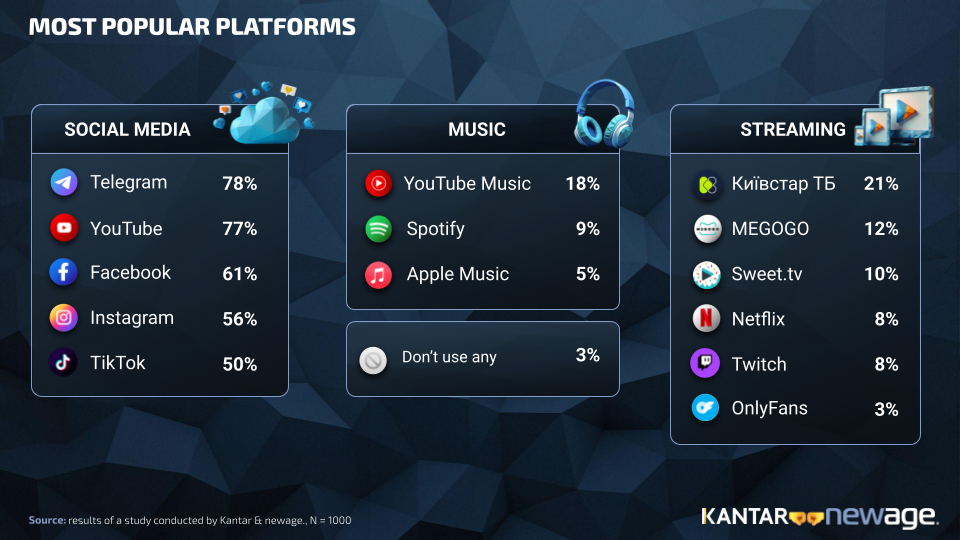
These figures demonstrate that audiences are not concentrated on just one or two channels. A single user may watch YouTube, communicate via Telegram, listen to Spotify, and use streaming services at the same time. This is why a large user base on a particular platform does not necessarily translate into an equivalent increase in incremental reach.
47% of users have a Premium subscription to at least one digital service. On some platforms, Premium subscribers represent a significant share of the total audience. For example, out of approximately 15 million YouTube users, around 3.1 million are Premium subscribers.
This does not mean that Premium audiences are completely out of reach for advertisers. Some of these users can still be reached on other platforms.
Therefore, actual reach depends on more than just the overall size of the internet audience. It is influenced by audience overlap across platforms, the share of paid subscriptions, the availability of advertising inventory, and the combination of channels included in the media plan. To increase unique reach, brands need to go beyond simply increasing ad frequency on Meta or YouTube. They need to understand which audiences have already been reached, identify existing gaps, and determine which additional platforms can provide genuinely incremental contact with users.

Where to Find New Audiences Today
Expanding the media mix does not mean that brands need to abandon YouTube, Meta, or Google Ads. Traditional channels continue to provide scale, advanced targeting capabilities, and predictable media buying.
Alternative platforms should instead be viewed as an extension of the core media mix. They help brands reach audiences in different contexts and create additional touchpoints beyond traditional advertising channels.
Twitch
Twitch is often perceived primarily as a platform for video game streaming. In reality, its content goes far beyond gaming: users watch esports tournaments, talk shows, music streams, and interact with streamers in real time. Just Chatting is currently the most popular category on the platform.
Twitch has an audience of approximately 3.9 million users in Ukraine, predominantly younger demographics. Users aged 18–24 account for 52% of the audience, while another 29% are aged 25–34. Another important point is that 87% of Twitch users do not watch broadcast television. This gives brands an opportunity to reach younger audiences who may be harder to engage through traditional video channels.
Who it’s for. Twitch is particularly relevant for brands targeting younger digital audiences, including tech companies, digital services, banks, automotive brands, and entertainment and lifestyle companies. It is also a natural fit for campaigns related to gaming, esports, and youth culture.
Ad formats. Twitch’s official advertising tools are currently unavailable in Ukraine, but brands can still build a presence on the platform through partnerships with streamers and esports studios. Options include integrations directly into live streams, branded visual elements, host mentions, giveaways, and custom branded projects.
Advantages. One of Twitch’s key strengths is its highly engaged audience. Viewers do more than simply watch a stream: they participate in chats, react to what is happening, and discuss brand integrations in real time. Based on newage. experience, advertising placements on Twitch can generate brand conversations, drive website traffic, and positively impact other engagement metrics. As a general benchmark, potential reach through Stream Advisor was around 150,000–200,000 users, while Maincast delivered approximately 500,000–600,000. However, these figures can vary significantly depending on the game, tournament, and overall level of audience interest.
Limitations. Twitch is not always the right choice for campaigns seeking broad reach across all age groups. Effective communication also needs to reflect the platform’s culture: standard advertising approaches may be less effective than native integrations that fit naturally into a streamer’s content.
Spotify
Spotify allows brands to connect with audiences in a fundamentally different context — while they are listening to music or podcasts, working out, commuting, or working. This makes the platform a valuable addition to a media mix that is already dominated by visual formats.
In Ukraine, approximately 2.2 million people use Spotify’s free tier, with 94% of this audience aged 18–44. Another important feature of the platform is that around 90% of users listen to audio ads all the way through.
Who it’s for. Spotify is well suited to brands targeting younger and middle-aged audiences that want to complement video advertising with audio touchpoints or reach users at times when they are not looking at a screen.
Ad formats. Spotify’s advertising capabilities extend beyond audio. Advertisers can use 30-second audio ads between tracks, Video Takeover, Opt-In Video, Sponsored Session, display and overlay formats, Homepage Takeover, and sponsored playlists. Campaigns can be launched through Spotify Ad Studio or a DSP, including Display & Video 360, while Campaign Manager 360 can be used for tracking.
Advantages. Spotify allows advertisers to target audiences not only based on standard characteristics but also by music genre, artist, playlist, and listening context. For example, a brand can distinguish between users who listen to music while working out and those who choose relaxing playlists while working.
Testing the platform does not necessarily require a large initial investment: minimum budgets start at €15 per day and €250 per campaign.
At the same time, Spotify is generally best viewed not as a primary advertising channel, but as a complementary element of the media mix. Audio formats allow brands to extend communication beyond visual environments and create additional touchpoints with their audience.
The results of one of the campaigns presented during the conference illustrate this approach. Spotify delivered 1.16 million in reach and 3.239 million impressions, with an average frequency of 2.8. Brand Lift showed a 4.9% increase in ad recall, while the lift attributed to the audio format reached 7.3%. In this case, Spotify supported the core campaign by adding an additional audio touchpoint.
Limitations. Advertising is primarily available to users on the free tier. In addition, audio ads need to work independently of any visual elements. This means creatives should be specifically adapted for Spotify, with the brand name and key message communicated clearly and quickly through audio alone.
OTT and CTV Platforms
OTT and CTV services allow brands to deliver advertising while users watch video content over the internet. This environment includes online TV services, streaming platforms, and apps accessed via Smart TVs, smartphones, computers, and other connected devices.
Unlike traditional digital advertising, OTT and CTV enable brands to reach audiences within a professional video content environment, often viewed on a large screen. This is why these platforms are increasingly used as a digital extension of TV campaigns or as a way to build video reach beyond YouTube.
In Ukraine, these services already have substantial audiences: approximately 2.1 million users on Kyivstar TV, 3.4 million on MEGOGO, and 1.7 million on Sweet.tv. However, a platform’s total user base does not equal its potential advertising reach. Some users have paid subscriptions, while the size of the audience available to advertisers depends on each platform’s specific monetization model.
Who it’s for. OTT/CTV is worth considering for advertisers that prioritize broad video reach and high-quality brand exposure. This includes FMCG, retail, financial services, pharmaceutical, automotive, and telecom brands. It can also be particularly valuable for companies already investing in television advertising and looking to extend their campaigns with digital capabilities.
Ad formats. Depending on the service, brands can use video ads before or during content, branded bumpers, sponsorship opportunities, and branded content collections. Available formats, targeting options, placement terms, and budgets vary by platform and its advertising partners.
Advantages. Ads are displayed within professional video content, often on a large screen with the sound on. OTT/CTV can extend TV reach, help manage frequency, and connect with audiences who are watching linear television less frequently.
Limitations. Targeting precision, measurement capabilities, and available advertising inventory vary across OTT and CTV platforms. Basic media metrics, such as reach, impressions, and frequency, are generally available, while conversion measurement — including through Campaign Manager 360 — may be more limited. Advertising inventory is also dynamic and strongly influenced by content popularity. Major sports broadcasts, premieres, and other special events can cause significant short-term fluctuations in available inventory.
Telegram
Telegram is one of the most widely used digital platforms in Ukraine. According to the Kantar and newage. study, 78% of respondents use Telegram, while the platform’s estimated audience in Ukraine is around 14 million people. Moreover, approximately 2.5 million of YouTube’s 3.1 million Premium users can also be reached on Telegram — an audience that is no longer accessible through standard advertising on YouTube itself.
Who it’s for. With a vast range of channels covering different topics and interests, Telegram can be relevant to almost any business category. It is particularly suitable for financial and technology companies, e-commerce, education and entertainment projects, as well as brands targeting news-oriented and highly active digital audiences.
Ad formats. Brands can advertise on Telegram in several ways: through the platform’s official advertising tools, direct placements in relevant thematic channels, native integrations and special projects, partnerships with content creators, or by developing their own branded channels. The most suitable format depends on the specific goals of the campaign.
Advantages. Telegram allows brands to reach both broad audiences and highly specific interest-based communities. Placements in relevant channels appear within a context that users have actively chosen to follow, making advertising messages feel like a natural part of their content feed.
Limitations. Channel quality and the reliability of audience statistics can vary significantly. For direct placements, advertisers should evaluate actual post views, audience growth dynamics, the share of sponsored content, and potential artificial engagement. Telegram is also already widely used by advertisers, so simply being present on the platform does not guarantee visibility.
Other Platforms Worth Testing
An alternative media mix is not limited to Twitch, Spotify, or streaming services.
Uklon. The platform’s core audience consists of urban users aged 18–45, including people with higher income levels. Uklon delivers approximately 3 million unique users per month and leverages its own first-party data for targeting, including location, age, gender, ride frequency, payment method, interests, and vehicle class.
In one newage. campaign, Uklon helped generate an additional 100,000 unique users among male car owners — an audience that could not be reached through other platforms.
Viber. The platform has more than 9.3 million users and reaches a broad range of age groups, from students to older audiences. Available formats include Chat List Ads, post-call banners, ads in the Calls tab, desktop display and video ads, branded stickers, and AR lenses. Minimum budgets start at €100, while CPM is estimated at approximately €1.15–2.55.
Threads. The platform has an audience of approximately 3.15 million users, with IT professionals, creators, and young professionals representing a notable share. Available ad formats include image, video, carousel, and Advantage+ Catalog ads, although placements are launched together with Instagram Feed. The entry cost is relatively low: advertising is, on average, 40% cheaper than on Instagram, with CPM ranging from approximately €0.5 to €2.
Roblox. The platform is primarily focused on Gen Alpha, Gen Z, creators, and gamers. Its monthly active audience is estimated at 2–5 million users, with 300,000–800,000 daily active users. Roblox supports banners, video ads, Sponsored Experiences, Portal Ads, Search Ads, and Rewarded Video. Brands can also create their own virtual worlds where users actively engage with the brand rather than simply viewing an ad.
Each of these channels has a smaller scale than YouTube or Meta. However, their value lies not in replacing traditional platforms, but in helping brands achieve incremental unique reach, connect with specific audience segments, and engage users in less saturated advertising environments.

Targeting 2.0: New Data Sources for Finding Audiences
People use dozens of digital services every day. They listen to music, order deliveries, shop online, book rides, watch live streams, make payments, and use mobile services. Each of these interactions leaves a digital footprint that can provide a much more accurate picture of actual user behavior than a predefined list of interests.
This is why new data sources are becoming increasingly valuable for audience targeting. They allow advertisers to move beyond assumptions and build audience segments based on real behavioral signals.
Telecom Operator Data
Mobile operators collect vast amounts of anonymized data about subscriber behavior. This goes far beyond basic location information and can include a much broader range of behavioral signals.
For example, an operator may be able to identify:
- which areas a user visits most frequently;
- which apps they use regularly;
- how much time they spend online;
- which categories of websites they visit.
This makes it possible to build audience segments based on actual digital behavior. For example, instead of targeting a broad segment of users who are “interested in cars,” advertisers can reach people who regularly visit automotive websites or compare offers from car dealerships.
newage. applied this approach in a campaign for agricultural and motor equipment. The campaign targeted users who visited relevant industry websites or competitors’ websites at least three times per month. As a result, the conversion rate was 3.4 times higher, while CPA was 40% lower compared with a standard banner campaign.
Retail Data
Large retailers and marketplaces are becoming another valuable source of audience data.
Unlike advertising platforms, they know not only what users browse, but also what they actually buy. This makes it possible to build much more precise audience segments.
For example, retail networks can analyze:
- the product categories a user purchases;
- purchase frequency;
- average order value;
- repeat purchases;
- loyalty to specific brands.
For example, Fozzy Media Group reaches more than 10 million users per month. Its data can be used to identify buyers of specific product categories, target regular consumers of a particular type of product, or, conversely, exclude customers who are already loyal to a competing brand. This allows advertisers to reach audiences with verified purchase behavior rather than relying only on assumed interest.
Logistics Services
Logistics companies are also becoming a valuable source of audience data.
For example, the Nova Poshta app is used by around 8.3 million people every month. Services like this can build audience segments based on users’ actual activity.
For example, advertisers can identify:
- people who regularly receive online orders;
- active e-commerce shoppers;
- business customers;
- marketplace sellers;
- small and medium-sized business owners.
This makes it possible to reach audience segments that are extremely difficult to build using traditional interest-based targeting in advertising platforms.
This is why more advertising campaigns are moving away from broad interest-based targeting and toward the use of behavioral data from different digital ecosystems.
Today, the advantage belongs not to brands that simply buy more advertising, but to those that find their audience where competitors are not yet looking. As a result, alternative platforms are no longer just experimental tools — they are increasingly becoming an essential part of an effective media strategy.
At newage., we help brands find new touchpoints with their audiences. We analyze which platforms potential customers use, build the optimal media mix, and integrate alternative advertising channels to expand reach, increase brand awareness, and improve overall campaign effectiveness.
The newage. team works with a wide range of digital platforms — from Google Marketing Platform and Meta to Spotify, Twitch, OTT/CTV, marketplaces, mobility services, and other advertising ecosystems. We also use alternative data sources to identify audiences based on real behavioral signals rather than relying solely on standard interest-based targeting.
If you want to expand your advertising reach, test new channels, or find audiences that have not yet interacted with your brand, contact the newage. team. We will help you build a media strategy tailored to your business goals.
FAQ: Frequently Asked Questions About Finding New Audiences in Digital
Should Brands Switch Entirely to Alternative Advertising Platforms?
No. In most cases, the best results come from combining traditional and alternative channels. Google Ads, Meta, and YouTube provide scale and predictable reach, while Twitch, Spotify, OTT/CTV, Telegram, and other platforms can help brands reach incremental audiences, reduce exposure to advertising clutter, and improve the overall effectiveness of the media mix.
How Do I Know Whether an Alternative Advertising Channel Is Right for My Business?
The right platform depends not on its overall popularity, but on your target audience and marketing objectives. Before launching a campaign, it is important to understand where potential customers spend their time, which services they use, and whether a particular channel can deliver incremental unique reach or a higher-quality brand interaction.
What Are Alternative Data Sources for Targeting?
Alternative data sources include information collected by digital services, mobile operators, retailers, marketplaces, logistics companies, and other platforms. This data reflects actual user behavior and makes it possible to build more precise audience segments than traditional targeting based solely on interests or demographic characteristics.
Is Advertising on Alternative Platforms More Expensive?
Not necessarily. Costs depend on the specific platform, ad format, target audience, and level of competition. In some cases, CPM may be higher than on traditional channels, but the campaign can deliver greater incremental reach or better business results, ultimately making the investment more efficient.
How Can You Measure the Effectiveness of New Advertising Channels?
Alternative platforms should not be evaluated solely based on CPM or the number of impressions. It is important to analyze incremental unique reach, frequency, Brand Lift, Search Lift, audience engagement, website traffic, conversions, and the channel’s contribution to the overall performance of the media mix. A comprehensive analysis helps determine the actual value a new channel adds to the advertising strategy.


Get deeper into digital!
Subscribe to the newage. digital digest and receive exclusive bonus content