


August 21, 2023
Measuring impressions, clicks, and conversions shows what happened during an advertising campaign, but it does not always explain whether those results happened because of the advertising. This is where Lift Studies come in.
Guide to Google’s Lift Studies: Brand Lift, Search Lift, Conversion Lift
August 21, 2023
Measuring impressions, clicks, and conversions shows what happened during an advertising campaign, but it does not always explain whether those results happened because of the advertising. This is where Lift Studies come in.
newage. blog
Google Lift Studies help advertisers measure the incremental impact of campaigns by comparing users who were exposed to advertising with those who were not. Depending on the study, they can show whether advertising influenced brand perception, search behavior, or conversions.
In this guide, we explain how Brand Lift, Search Lift, and Conversion Lift work, what each study measures, and when to use them to evaluate the real impact of advertising.
What Are Google Lift Studies and How Do They Work?
Google Lift Studies are a method of measuring the incremental impact of advertising by comparing two groups of users: those who were exposed to an advertising campaign and those who were not.
To make this comparison possible, the system creates a control group — a segment of the target audience that is intentionally not exposed to the campaign. The behavior or responses of this group are then compared with those of the exposed group. The difference between them helps determine what additional effect can be attributed to advertising rather than to other factors.
Depending on the type of study, this approach can be used to measure changes in brand perception, search behavior, or conversions. This is what distinguishes lift measurement from standard campaign reporting: impressions, clicks, and attributed conversions show what happened, while a lift study is designed to estimate what happened because of the advertising.
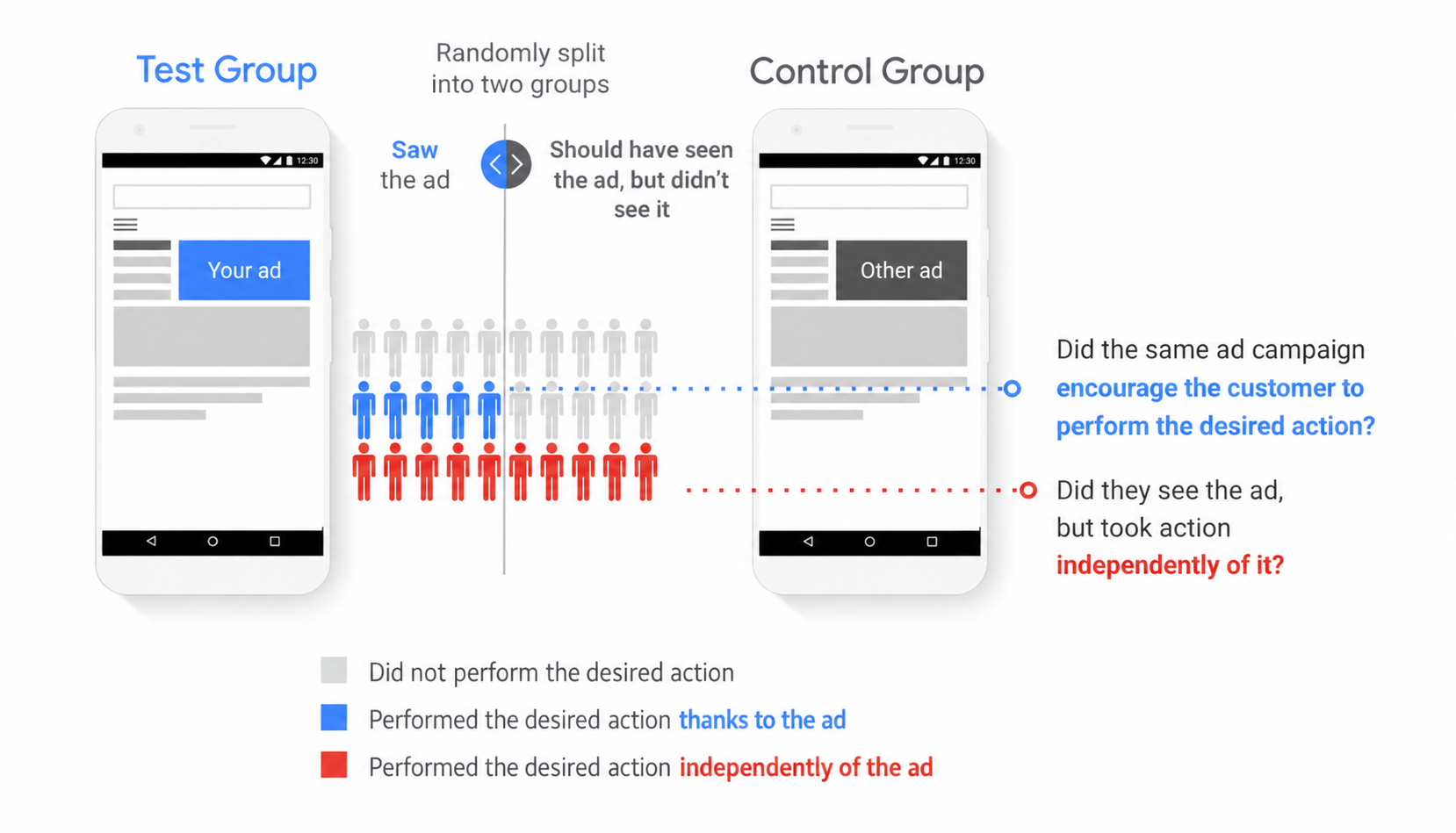
An important requirement is that a Lift Study should be planned and set up before the advertising campaign begins. If measurement starts after campaign impressions have already been delivered, users who should belong to the control group may have already been exposed to the ads, which can affect the reliability of the comparison.
Because a portion of the eligible audience is intentionally withheld from advertising, running a Lift Study can reduce the campaign’s potential reach to some extent. However, this separation is necessary to create a valid control group and measure incremental impact.
Lift Studies are particularly useful when advertisers need to go beyond standard media metrics and answer questions such as: Did the campaign increase brand awareness? Did it generate additional searches? Did it cause conversions that would not otherwise have happened?
For this reason, Lift Studies can be especially valuable when testing new strategies, creatives, audiences, or campaign approaches. They provide experimental evidence that can be used to evaluate advertising effectiveness and make future optimization decisions based on measured incremental impact rather than attribution alone.
Types of Google Lift Studies: Brand Lift, Search Lift and Conversion Lift
Google offers several types of Lift Studies, each designed to measure a different stage of advertising impact. While Brand Lift focuses on changes in perception, Search Lift measures additional search interest, and Conversion Lift evaluates incremental actions or conversions.
All three approaches are based on comparing an exposed audience with a control group, but they answer different business questions.
| Lift Study | What It Measures | How It Is Measured | Best Suited For |
| Brand Lift | Changes in brand awareness, perception, consideration, and purchase intent | Surveys among exposed and control groups | Brand awareness and consideration campaigns |
| Search Lift | Incremental searches generated by advertising | Comparison of search behavior between exposed and control groups | Measuring additional interest in a brand, product, or category |
| Conversion Lift | Incremental conversions caused by advertising | Comparison of conversion behavior between exposed and control groups | Conversion-focused and performance campaigns |
Google Brand Lift: Measuring Brand Perception
Google Brand Lift helps advertisers understand whether an advertising campaign changed how people perceive or think about a brand.
The study compares responses from users who were exposed to advertising with responses from a control group that was not exposed. Google uses short surveys to measure indicators such as ad recall, brand awareness, consideration, favorability, and purchase intent, depending on the study setup.
The difference between the exposed and control groups indicates the incremental change associated with the campaign. This allows advertisers to move beyond reach, impressions, and video views and evaluate whether advertising actually influenced brand-related attitudes.
Brand Lift can be particularly useful for upper- and mid-funnel campaigns where the immediate objective is not necessarily a conversion but a change in awareness, preference, or consideration.

The results can be expressed as both absolute lift and relative lift. This distinction is especially useful when baseline brand metrics are low: a relatively small change in percentage points can still represent significant proportional growth.
For a more detailed explanation of the methodology and practical application, see our guide “What is BrandLift and how we do it“
Google Search Lift: Measuring Incremental Search Interest
Google Search Lift measures whether exposure to an advertising campaign leads users to search more frequently for a brand, product, or related topic in Google Search or on YouTube.
As with other Lift Studies, Google separates the eligible audience into exposed and control groups. Instead of collecting survey responses, Search Lift compares subsequent search behavior.
Advertisers define the keywords or groups of queries they want to measure before the study begins. It is usually useful to include both branded queries and product- or category-related queries to understand whether the campaign generated additional interest beyond searches for the brand itself.
Keyword selection matters. Queries need enough search activity to generate statistically meaningful results. A broad product query is therefore generally more useful for measurement than a highly specific long-tail phrase that only a small number of users are likely to search for.
Search Lift can reveal effects that are difficult to identify through a simple before-and-after comparison in Search Console. Changes in overall search demand may be influenced by seasonality, competitor activity, or other external factors, while an experimental design allows the exposed and control groups to be compared during the same period.

For example, in one of our projects, the study did not identify meaningful growth in branded searches but showed a +31% relative lift in searches for the client’s main product-related keywords. This indicated that the advertising generated additional category interest even though the effect was not visible in branded queries.
Google Conversion Lift: Measuring Incremental Conversions
Google Conversion Lift helps determine how many conversions were generated because of advertising rather than simply attributed to it.
The study compares conversion behavior between users who had the opportunity to be exposed to the campaign and a control group that was withheld from that advertising. Google then estimates the incremental conversions generated by the campaign.
This distinction is important because standard attribution answers the question “Which advertising interaction received credit for the conversion?”, while Conversion Lift addresses a different question: “Would this conversion have happened without the advertising?”
Depending on the campaign and measurement setup, conversions may include purchases, leads, registrations, or other actions tracked in the advertiser’s account.
Conversion Lift results can include both absolute and relative lift. Absolute lift represents the additional number or rate of conversions associated with the campaign, while relative lift shows how much higher conversion behavior was among the exposed audience compared with the control group.
This makes Conversion Lift particularly valuable when advertisers need to evaluate incrementality, validate whether campaigns are generating additional business outcomes, and make budget decisions based on causal impact rather than attribution alone.
The exact eligibility requirements and setup options for Conversion Lift may change depending on Google Ads products and campaign configurations, so advertisers should refer to the current Google Ads documentation when preparing a study.

Which Google Lift Study Should You Choose?
The right Google Lift Study depends primarily on what effect of advertising you want to measure. Brand Lift, Search Lift, and Conversion Lift focus on different stages of the customer journey, so the choice should be based on the campaign objective rather than on the advertising format alone.
Choose Brand Lift if you want to measure changes in brand perception
Brand Lift is most suitable when the campaign is focused on awareness, consideration, or brand preference rather than immediate actions.
It can help answer questions such as:
- Did more people become aware of the brand after seeing the campaign?
- Did ad recall increase?
- Did the campaign improve consideration or purchase intent?
- Did users’ perception of the brand change?
This makes Brand Lift particularly useful for brand campaigns where clicks or conversions alone cannot fully reflect the impact of advertising.
Choose Search Lift if you want to measure additional search interest
Search Lift is useful when you want to understand whether advertising encouraged people to actively search for your brand, product, or category.
For example, a campaign may not immediately generate a conversion, but users who saw the ad may later search for the brand or product. Search Lift helps identify this incremental behavior by comparing search activity between exposed and control groups.
It can be especially valuable for campaigns designed to stimulate interest and demand, where search behavior acts as a signal between brand exposure and a future action.
Choose Conversion Lift if you want to measure incremental conversions
Conversion Lift is the most relevant option when the main question is whether advertising actually generated additional business actions.
Instead of simply attributing conversions to advertising interactions, the study estimates how many conversions would not have happened without the campaign.
This makes Conversion Lift useful for evaluating performance-oriented campaigns and answering questions such as:
- Did the campaign generate incremental purchases or leads?
- How many conversions were caused by advertising?
- Would some of these conversions have happened anyway?
- Is the campaign creating additional business value rather than only receiving attribution credit?
Absolute vs Relative Lift: How to Interpret Lift Study Results
To correctly interpret results from Brand Lift, Search Lift, or Conversion Lift, it’s important to understand two key types of lift that Google uses: absolute lift and relative lift. They measure the same effect but reflect its scale differently, providing different levels of analysis depth.
Absolute lift shows the difference in the metric between the experimental and control groups in percentage points.
Absolute Lift = Exposed Rate – Control Rate
For example, if 5% of the audience that saw the ad performed the target action, and in the control group 2%, then the absolute lift will be +3 p.p.
Absolute Lift = 5% – 2% = +3 p.p.
This is a simple and clear way to evaluate direct growth.
Relative lift demonstrates how much stronger the audience that saw the ad performed compared to the control group.
Relative Lift = (Exposed Rate – Control Rate) / Control Rate × 100%
For the same difference of 5% vs. 2%, relative lift will be +150%, meaning users from the experimental group acted 1.5 times more frequently.
(5% – 2%) / 2% × 100% = 150% relative lift
This metric is especially useful when baseline values are low — it reveals the real scale of changes that absolute values don’t always reflect.
Absolute lift allows evaluating the actual increase, while relative lift shows the strength of the ad’s impact. Together, they provide a complete picture: both about the number of additional actions and how significantly the campaign changes audience behavior. That’s why analyzing lifts without considering both metrics can be incomplete or even misleading.

How and When to Run Google Lift Studies
Running a Lift Study requires planning before the advertising campaign begins. Since lift measurement relies on comparing exposed and control groups, the study setup needs to be aligned with the campaign structure, measurement objectives, and other advertising activity running at the same time.
When to Set Up a Lift Study
A Lift Study should be planned and configured before campaign impressions begin. This allows Google to correctly separate eligible users into exposed and control groups and reduces the risk that users assigned to the control group have already been exposed to the advertising being measured.
The study period should also provide enough scale and time to collect sufficient data. The exact requirements depend on the type of Lift Study, campaign setup, audience size, budget, and the outcome being measured.
For this reason, lift measurement should be treated as part of campaign planning rather than as an analysis added after the campaign has already started.
It is particularly useful when advertisers want to test a new creative approach, audience, media strategy, or campaign hypothesis and need to understand whether the observed changes were actually caused by advertising.
Should You Run Brand Lift, Search Lift and Conversion Lift Together?
When measurement conditions allow, combining several Lift Studies can provide a more complete understanding of advertising impact across different stages of the customer journey.
At newage., our approach is to run Search Lift and Conversion Lift alongside Brand Lift when the campaign setup makes this possible. This allows us to analyze how the same advertising affects different outcomes — from brand perception and search interest to final conversions.
Ideally, the studies should be synchronized within the same campaign period. Brand Lift, particularly Ad Recall, can provide useful context for interpreting the other results because it indicates whether the advertising message was actually noticed by the audience.
For example, a campaign may generate measurable Ad Recall Lift but no significant Search Lift. This can indicate that users noticed the advertising but it did not lead to additional search behavior. Alternatively, an increase in Search Lift or Conversion Lift can provide evidence of behavioral impact beyond changes in brand metrics.
The goal is not necessarily to run every available study for every campaign, but to combine measurement methods when they help answer different parts of the same business question.
How to Run Lift Studies Across Parallel Campaigns
Additional planning is required when multiple advertising campaigns run simultaneously. Users assigned to the control group for one campaign may potentially be exposed to another campaign from the same advertiser, creating cross-influence that can make the results more difficult to interpret.
There are two main approaches to structuring lift measurement in this situation:
- Run one overall Lift Study across the relevant advertising activity. This provides a broader view of the combined incremental impact of campaigns and helps maintain consistent exposed and control groups.
- Run separate Lift Studies for individual campaigns. This approach may be useful when campaigns test substantially different creatives, audiences, strategies, or hypotheses and their effects need to be evaluated separately.
The appropriate setup depends on the campaign structure and the question the study needs to answer. A single broader study may be preferable when the goal is to understand the overall advertising effect, while separate studies can provide more granular insights when individual campaign strategies need to be compared.
For complex setups with several campaigns or overlapping audiences, the measurement design should therefore be determined before launch. This helps minimize audience overlap, preserve the validity of control groups, and ensure that Lift Study results can be interpreted in the context of the specific campaign hypothesis being tested.
Conclusions
Google Lift Studies help advertisers move beyond standard campaign metrics and understand what changed specifically because of advertising. Brand Lift, Search Lift, and Conversion Lift measure different types of incremental impact — from changes in brand perception and search interest to additional conversions.
The right measurement approach depends on the campaign objective, but the key is to plan Lift Studies before launch and connect the results to broader campaign analysis rather than evaluate them in isolation.
At newage., we help brands plan and run Lift Studies, interpret the results, and combine them with advertising and analytics data to understand the real impact of media campaigns. Contact us if you want to build a measurement approach tailored to your campaign and business goals.
FAQ
Does launching Lift Studies affect campaign reach?
Yes, part of the audience is reserved for the control group and does not see the ad. However, this minimal reduction in reach is compensated by precise insights into the real impact of the campaign, allowing for more accurate budget optimization.
Can lift studies be launched for an already active campaign?
No. Lift Studies must be activated before impressions start, otherwise the system cannot correctly form the control group, and results will be distorted.
What is the difference between absolute lift and relative lift?
Absolute lift shows the difference between groups in percentage points. Relative lift demonstrates how much stronger the experimental group reacted to the ad compared to the control group, in percentages. Together, they provide a complete picture of the impact.
Why launch Search Lift and Conversion Lift together with Brand Lift?
Brand Lift captures the baseline level of ad recall and perception. Without it, it’s hard to interpret growth in search or conversions, as it’s unclear whether the audience actually noticed the ad.
What does Google Conversion Lift measure?
Google Conversion Lift measures incremental conversions — actions that occurred because of advertising and would not otherwise have happened. It does this by comparing conversion behavior between exposed and control groups.


Get deeper into digital!
Subscribe to the newage. digital digest and receive exclusive bonus content