
June 17, 2026
Following February 24, 2022, Ukraine’s digital landscape began to change rapidly. Across social media platforms, YouTube, Telegram, and streaming services, we witnessed a large-scale shift toward the use of the Ukrainian language.
Is Ukrainian Losing Ground Online? Insights from a newage. Research Study
June 17, 2026
Following February 24, 2022, Ukraine’s digital landscape began to change rapidly. Across social media platforms, YouTube, Telegram, and streaming services, we witnessed a large-scale shift toward the use of the Ukrainian language.
Svitlana Kryskova
Last year, the newage. team explored these changes using open data and machine learning tools. The findings revealed a clear trend: Ukrainian was steadily becoming the dominant language of online communication. However, over time, a new question emerged — has this trend continued? Are we still moving toward greater adoption of the Ukrainian language online?
That is why we decided to revisit the research — this time on a much larger scale.
Our goal was not simply to collect another set of statistics. We wanted to answer a broader question: what does the linguistic landscape of the Ukrainian internet look like today? Where has Ukrainian already become the unquestioned norm, and where is the transition still underway?
Research Methodology
For this new phase of the study, we significantly expanded both the volume of data and the number of platforms included in the analysis. In total, we examined more than 2 million user comments and messages across different segments of Ukraine’s digital ecosystem.
It is important to note that this study focuses not on the language of the content produced by creators, media outlets, or channel owners, but on the language used by their audiences in comments and discussions. Our interest was not in the language spoken by bloggers or used by editorial teams, but in the language people themselves choose when interacting online.
We recognize that online comments are not a perfect reflection of everyday offline communication. However, they remain a valuable indicator of linguistic behavior, especially when the dataset spans a wide range of platforms, communities, content categories, regions, and audience segments.
The dataset included:
- YouTube channels across multiple content categories (approximately 1.5 million comments analyzed);
- Telegram channels and public discussions (approximately 200,000 comments analyzed);
- Twitch streams and streaming communities (approximately 150,000 messages analyzed);
- Regional Telegram channels from cities across Ukraine (approximately 300,000 comments analyzed).

For the analysis, we combined open data sources with our own automated data collection and processing system. The dataset was processed using machine learning models for language identification, including LangDetect, which allowed us to classify comments into three categories:
- Ukrainian;
- Russian;
- Other languages or emoji-only messages.
It is also important to recognize that the digital space is not a perfect reflection of the country as a whole.
Online communication is shaped by platform algorithms, information bubbles, and the unique dynamics of different communities. At the same time, the internet remains one of the most reliable indicators of broader social change, particularly when it comes to the everyday language habits of millions of people.
YouTube: Ukrainian Has Become the Language of Mainstream Content
Today, YouTube is one of the clearest indicators of linguistic change within Ukraine’s digital space. It provides insight not only into the language in which content is created, but also into how audiences across different segments interact with one another — from entertainment and stand-up comedy to politics, sports, and educational content.
Our analysis shows that Ukrainian has firmly established itself across most YouTube categories. At the same time, different segments continue to exhibit different patterns: in some communities, Ukrainian has already become the unquestioned norm, while in others the linguistic environment remains mixed or is still undergoing transformation.
Entertainment YouTube
Traditionally, the entertainment segment has been considered one of the most challenging areas for the adoption of Ukrainian. Today, however, the picture looks very different. An analysis of comments under popular entertainment videos shows that Ukrainian now dominates audience interactions across most major channels.
Among the highest shares of Ukrainian-language comments are:
- Pidpilnyi Standup (85%);
- SEREDA (82%);
- Levy na Dzhypi (81%);
- Feliks Redka (76%);
- Durnev (76%).
Even on channels with more diverse audiences, Ukrainian often either dominates or is close to becoming the primary language of communication.
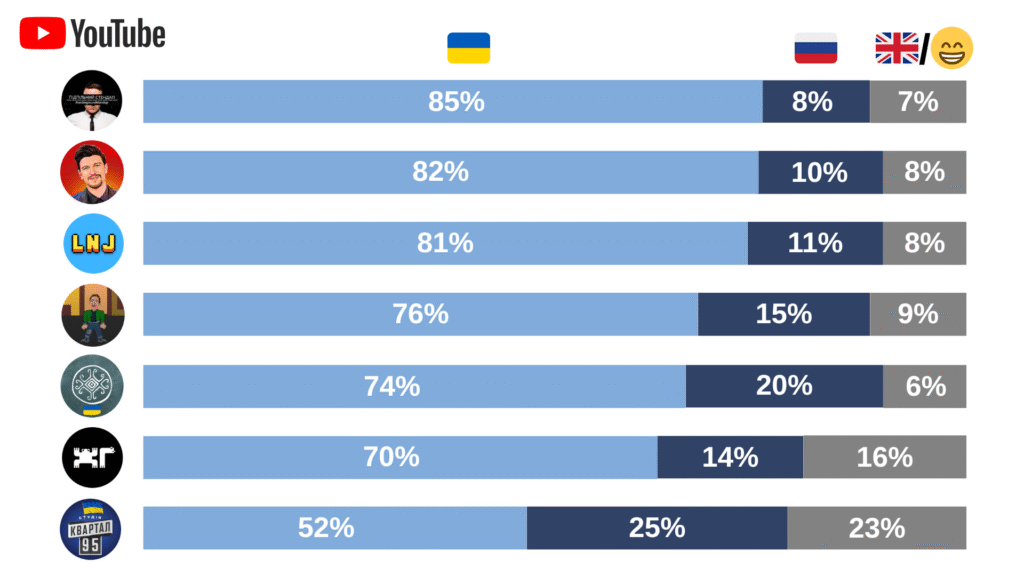
At the same time, some major entertainment projects still have a mixed linguistic profile. For example, in Kvartal 95, Ukrainian-language comments account for 52% of the total, reflecting an almost even split between Ukrainian and other languages.
Educational and Cultural YouTube
The educational and cultural segment deserves special attention. Over the past few years, Ukrainian-language content in this space has not only grown but has effectively developed into a mature digital ecosystem with a stable audience and high levels of engagement.
Channels such as Geek Journal (86%), Istoriia Bez Mifiv (86%), Kliatyi Ratsionalist (90%), Zahin Kinomaniv (87%), and Bezodnya Music (86%) all demonstrate exceptionally high shares of Ukrainian-language interaction in their comment sections. This is particularly significant because only a few years ago, a substantial portion of the audience for cultural, educational, and review-based content on Ukrainian YouTube remained heavily influenced by the Russian-language information space.
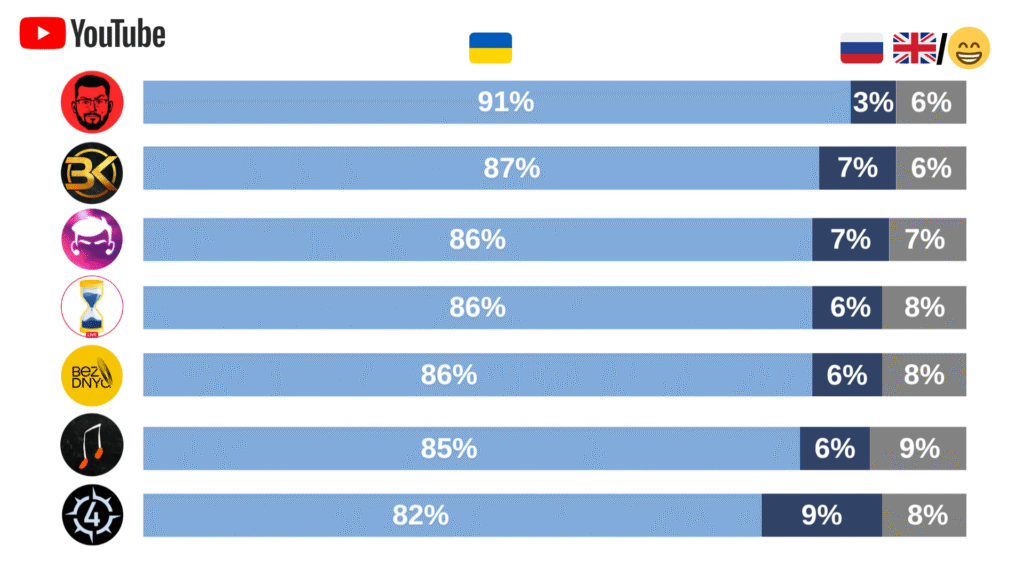
Today, however, the situation has changed. Ukrainian is actively used to discuss films, music, history, pop culture, science, and social issues.
Political and Public Affairs Content
The political and public affairs segment of YouTube remains a more turbulent environment. Unlike entertainment or cultural content, it is much more heavily influenced by information operations, bot activity, and external traffic sources.
For example, Ukrainian-language comments account for 63% of interactions on Serhii Sternenko’s channel, 72% on Yevhen Karas’s channel, 55% on Serhii Yahodzynskyi’s channel, and 47% on Oleksii Honcharenko’s channel.
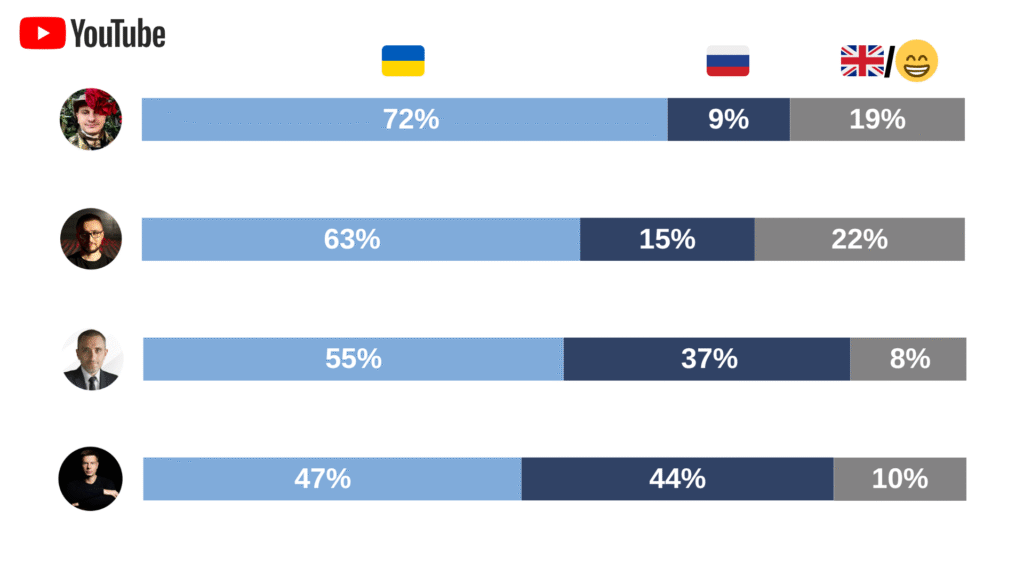
These figures do not always reflect the true linguistic composition of a channel’s audience. Political content is far more likely to attract bot networks, Russian-speaking users, and audiences from outside Ukraine.
Despite this, Ukrainian maintains strong positions even within the most contentious and polarized segments. In many cases, it remains the dominant language of communication. This suggests that the shift toward Ukrainian is taking place not only in relatively “comfortable” content categories, but also in environments characterized by intense information pressure and high levels of public debate.
Gaming YouTube
Ukrainian is also becoming firmly established within the gaming community. For example, Ukrainian-language comments account for 77% of interactions on XGTV UA, 72% on Nika Karuso, 70% on Sanya Minecraft, and as much as 86% on OLDboi.
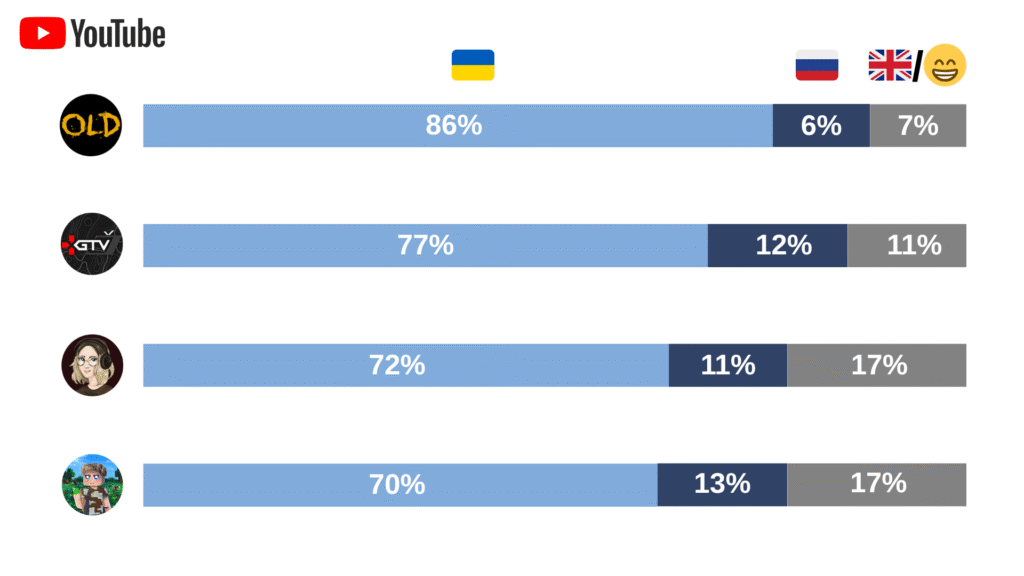
Just a few years ago, figures like these would have seemed almost unimaginable for the gaming segment. Today, however, Ukrainian is increasingly becoming the language not only of local gaming communities but also of mainstream content related to gaming, esports, and streaming.
Twitch: Youth, Streaming, and the Most Challenging Linguistic Environment
One of the new additions to this study was Twitch — a platform we analyzed for the first time. It also proved to be one of the most challenging environments for data collection and analysis.
Due to the platform’s unique structure, live-streaming format, and limited access to historical data, Twitch is rarely included in large-scale language studies. However, understanding what is happening within this ecosystem was important to us, as Twitch has become one of the key spaces where online youth communities are formed and shaped.
For this project, the newage. team developed a dedicated approach to collecting and analyzing Twitch data. This allowed us to include the streaming ecosystem in our broader picture of the Ukrainian internet for the first time and gain valuable insights into the language habits of Twitch audiences.
The results turned out to be particularly revealing.
Historically, Twitch has been one of the most Russian-dominated segments of the internet. For years, the gaming and streaming ecosystem was built largely around Russian-language content, and Ukrainian creators often had to adapt to that audience. As a result, Twitch provides one of the most revealing snapshots of language coexistence within Ukraine’s digital space today.
The data shows that Twitch remains the most linguistically diverse platform among those included in our analysis. At the same time, Ukrainian is steadily gaining ground, and on some channels it has already become the dominant language.
For example, Ukrainian-language messages account for 53% of interactions on the channels of vgostiua, i_reidman, and Skevich_, while Russian-language messages represent only 10–13%. On Leb1ga’s channel, Ukrainian also remains the largest language category, accounting for 49% of messages compared to 22% in Russian. The remainder consists of other languages and messages that could not be classified with sufficient confidence.
At the same time, there are still channels where Russian remains dominant. The most notable example is reznikbtw, where 60% of messages are written in Russian, while only 12% are in Ukrainian.
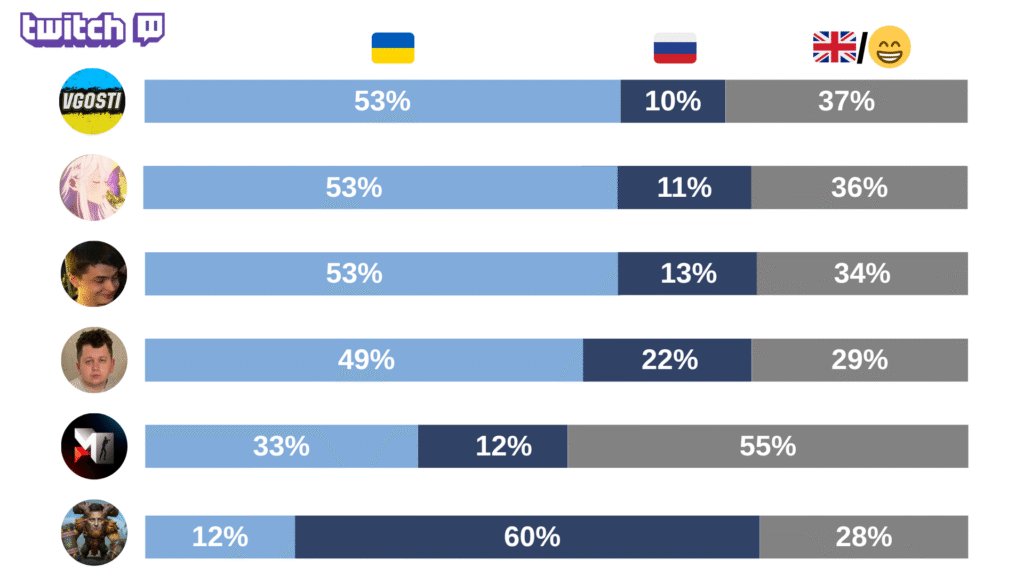
It is also worth noting the large share of messages classified as “other” — including English, mixed Ukrainian-Russian speech (surzhyk), emojis, internet slang, and hybrid language constructions. This is entirely natural for Twitch, where communication is far less formalized than on most other platforms and often develops in real time during live broadcasts.
Even so, the overall trend is clear: in a space that long remained one of the most Russian-dominated parts of the internet, Ukrainian is steadily becoming a more visible and influential part of digital culture.
Telegram and the Bot Effect
Telegram remains one of the most influential platforms in Ukraine’s information landscape, particularly within the news, political, and military sectors. This makes it especially important for language analysis, as Telegram not only reflects public sentiment but also frequently serves as a battleground for information influence campaigns and coordinated digital attacks.
Despite this, Ukrainian clearly dominates communication across most major Telegram channels today.
For example:
- On Forbes Ukraine, the share of Ukrainian-language comments increased from 83% in our previous study to 90%.
- On AIN.UA, the figure grew from 92% to 97%, effectively making Ukrainian the primary language of communication within the community.
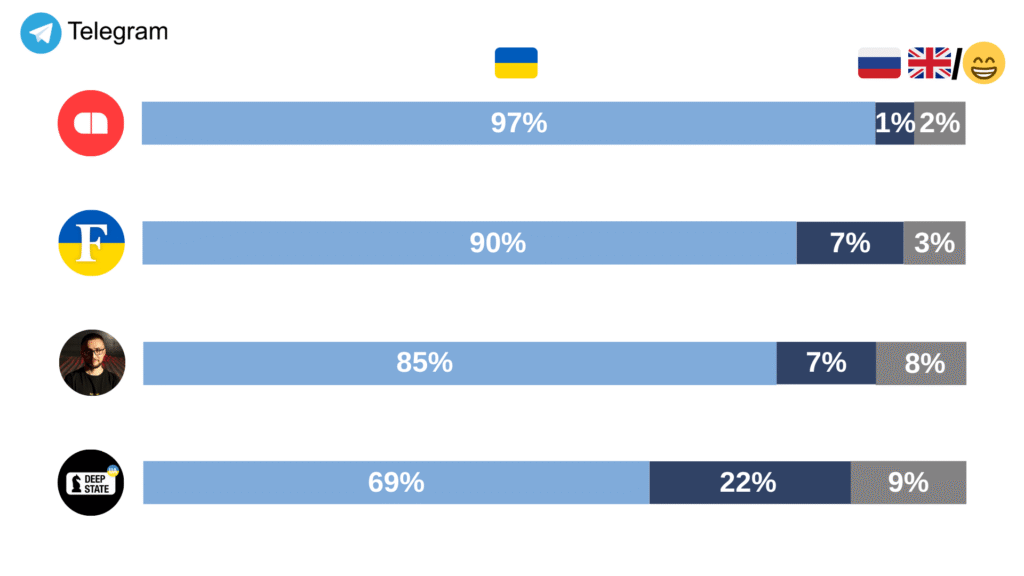
A similar trend can be seen on Serhii Sternenko’s channel, where the share of Ukrainian-language comments increased from 83% in our previous study to 85%.
At the same time, some channels show a different pattern. For example, on DeepState, the share of Ukrainian-language comments declined from 73% to 69%. However, context is crucial here: military and political Telegram channels are significantly more likely to become targets of external bot activity, information operations, and inflows of Russian-speaking traffic.
This is why Telegram is one of the few platforms where language statistics often reflect not only the organic behavior of audiences but also the level of information pressure surrounding a particular topic or channel.
In many cases, waves of Russian-language comments are not an indicator of the platform’s actual linguistic environment, but rather a signal of coordinated information activity. This is particularly visible on channels focused on military affairs, politics, and other socially significant topics.
Regions of Ukraine: How the Country’s Linguistic Map Is Changing
One of the most revealing parts of the study was the regional analysis of Telegram channels. This perspective allows us to see not only the overall trend, but also how differently language shifts are unfolding across various parts of the country.
Western Ukraine
In Western Ukraine, several cities continue to show further growth despite already having very high baseline levels of Ukrainian-language usage. For example, Lviv increased from 93% to 94%, while Khmelnytskyi rose from 77% to 95%.
The most notable change was recorded in Ternopil, where the share of Ukrainian-language comments increased from 82% to 98%, making Ukrainian virtually the universal language of communication within the analyzed communities.
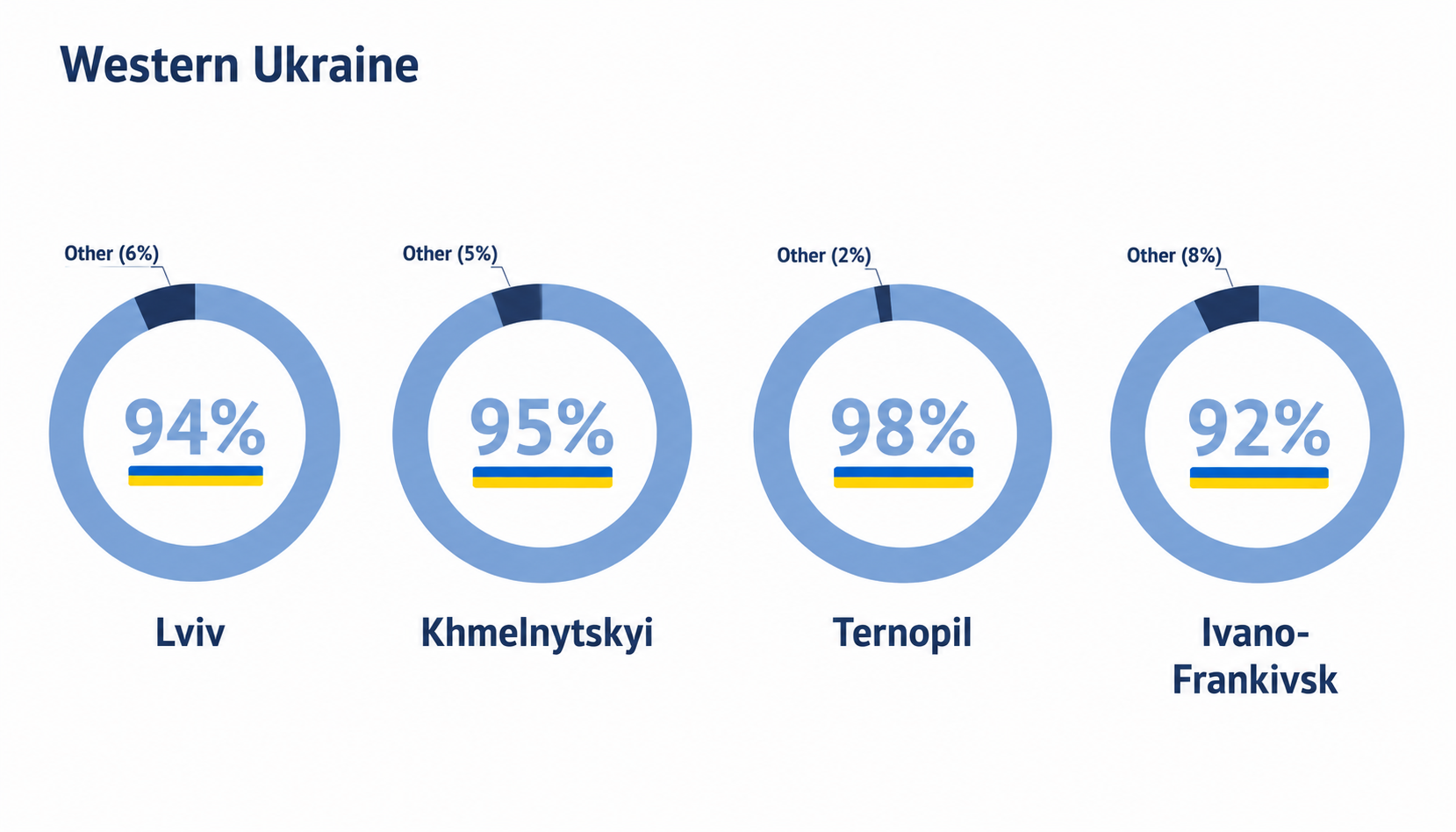
In practice, Ukrainian is no longer simply the dominant language in Western Ukraine — it has become the default language of digital communication.
Central Ukraine
Central Ukraine continues to demonstrate a steady shift toward Ukrainian, although the linguistic landscape here remains considerably more diverse than in the western part of the country.
In terms of recent changes, Vinnytsia increased from 88% to 91%, Zhytomyr remained stable at 88%, while Bila Tserkva showed a slight decline from 81% to 78%. Kyiv also recorded a decrease, with the share of Ukrainian-language comments falling from 86% to 77%.
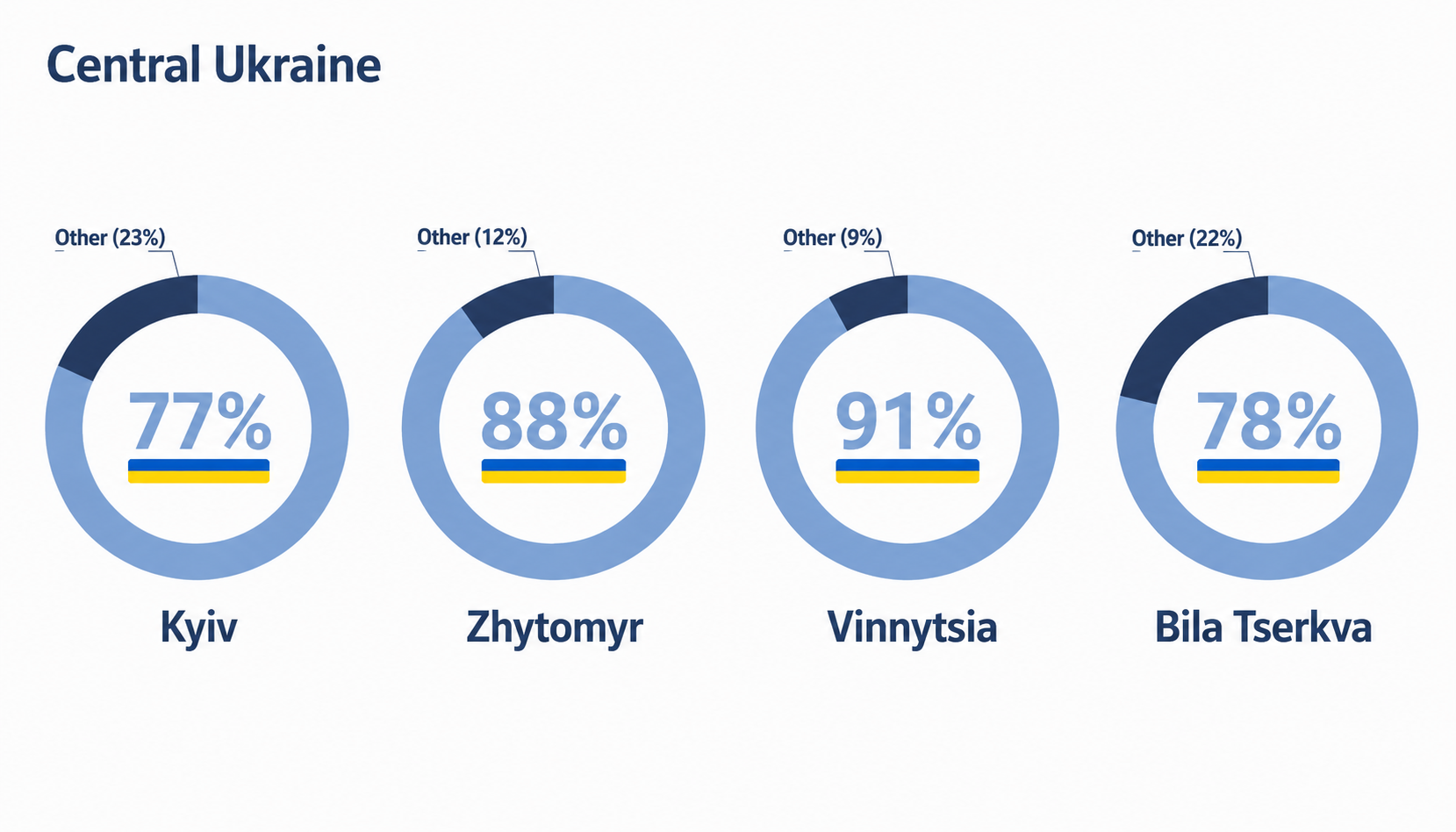
As part of the study, we analyzed not only major Telegram channels but also local public communities, including residential complex channels and neighborhood discussion groups. As a result, the average share of Ukrainian-language comments in Kyiv was 77%, although the figures varied significantly between communities, ranging from 54% to 91%. For this reason, the decline should not be interpreted solely as evidence of a language rollback. It is partly explained by changes in the sample itself and by the inclusion of a broader and more diverse range of urban communities in the analysis.
Eastern and Southern Ukraine
Just a few years ago, most cities in Eastern and Southern Ukraine were characterized by predominantly Russian-speaking digital environments. Today, however, the picture is gradually changing — and in many cases quite noticeably.
Kharkiv increased from 53% to 77% Ukrainian-language comments. This figure is based on the analysis of several local Telegram channels, where results vary depending on audience composition and content focus. At the same time, Ukrainian has already become the default language of communication in some Kharkiv communities. Mykolaiv increased from 65% to 80%, while Dnipro rose from 62% to 71%.
Odesa remains a more complex and heterogeneous case. As part of the new study, we analyzed a large number of local Telegram channels, and the citywide average turned out to be significantly lower — approximately 28%.
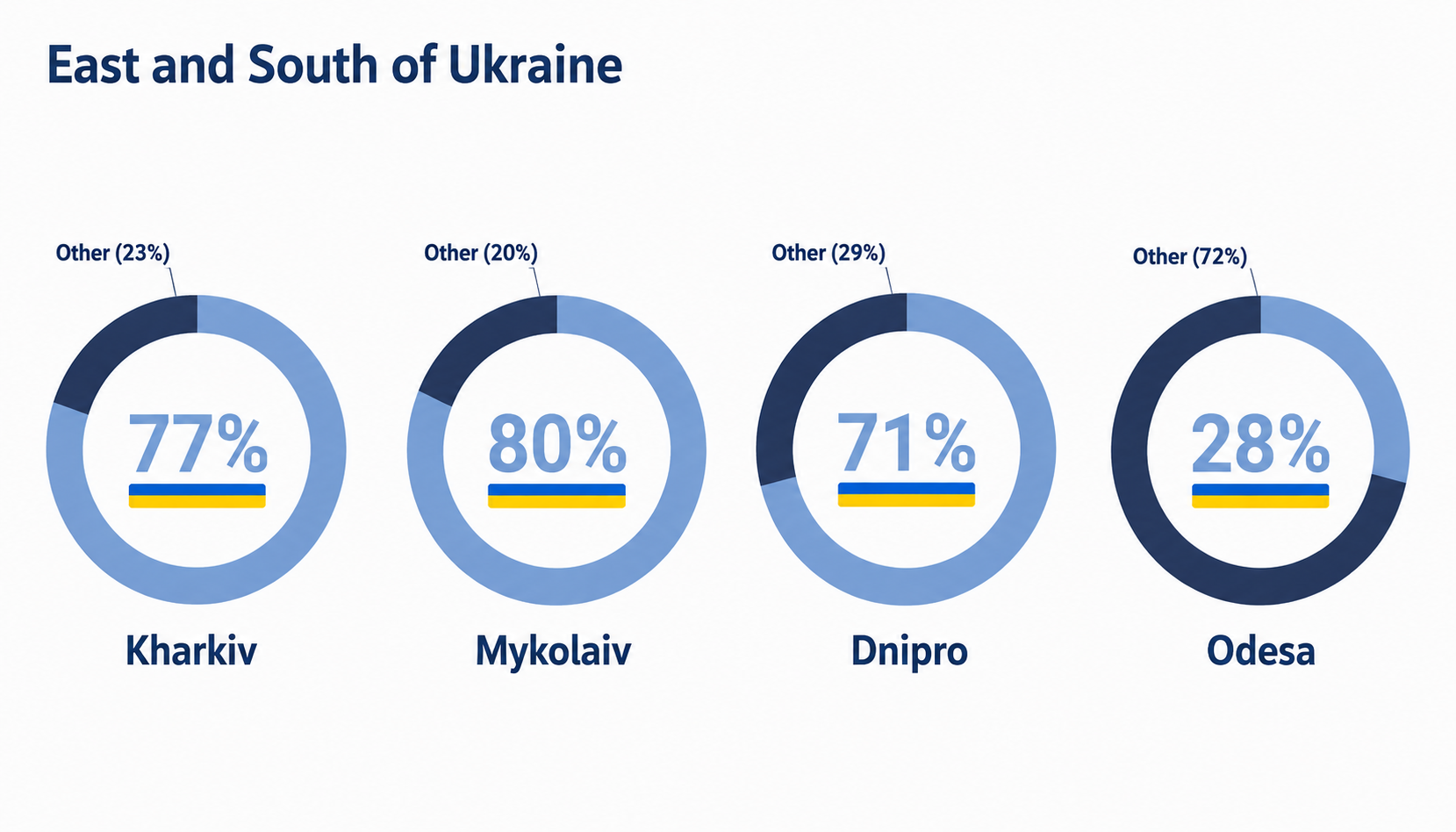
However, the variation between individual communities is substantial. In some channels, the share of Ukrainian-language comments is as low as 8%, while in others it reaches 61%.
It is also worth mentioning the temporarily occupied territories, where the share of Ukrainian-language comments remains between 1% and 10%. We will not examine these regions in detail, as the reasons behind such figures are largely self-evident.
The broader takeaway is more important: even in regions that have historically been considered the most Russian-speaking, Ukrainian continues to gain ground. In many cities, the share of Ukrainian-language communication is now two to three times higher than it was at the beginning of the full-scale invasion.
Is There Really a “Language Rollback”?
This is perhaps the most frequently debated question surrounding the linguistic landscape of the Ukrainian internet today. Discussions regularly appear on social media claiming that the use of Ukrainian is declining, that some audiences are shifting back to Russian, or that the wave of Ukrainian-language adoption that followed 2022 is beginning to lose momentum.
The data reveals a more nuanced picture. Local fluctuations do exist. In certain cities, on specific platforms, and within particular content segments, we do observe a decline in the share of Ukrainian-language comments.
Moreover, when compared with the peak levels recorded in 2024, the overall share of Ukrainian-language comments has indeed decreased slightly — from 73% to approximately 70%.
Can this be described as a language rollback? To some extent, yes. However, not on the scale often suggested in online discussions. While we observe a moderate decline in some indicators following the 2024 peak, Ukrainian remains the dominant language across most platforms and is significantly stronger than it was at any point before the full-scale invasion.
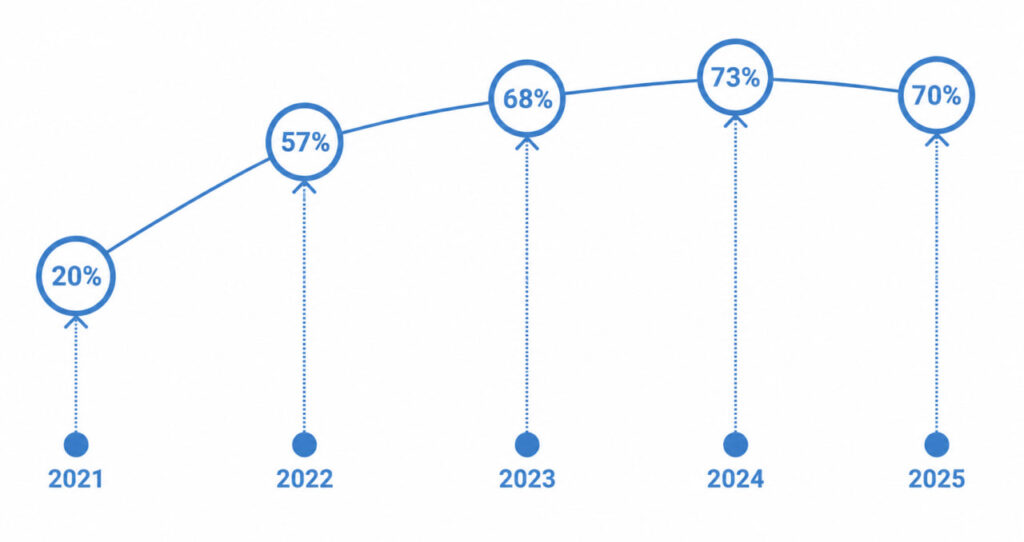
Today, the linguistic landscape of the Ukrainian internet no longer looks like a temporary wave of change. Instead, it increasingly resembles the emergence of a new digital norm. While just a few years ago Ukrainian dominated primarily within specific niches, it is now becoming firmly established across mainstream content and online communities.
The latest data suggests that even after the most emotionally charged phase of Ukrainian-language adoption in 2022, Ukrainian has not lost its position. On the contrary, it remains the primary language of interaction for a significant share of online audiences. Although the pace of change still varies across regions and platforms, the overall direction appears increasingly clear.
Most importantly, these changes are not being driven by enforcement or regulation. They are the result of millions of everyday choices made by users themselves. Ukrainian is gradually becoming the language of everyday digital communication, and the findings of our research strongly support that conclusion.


Get deeper into digital!
Subscribe to the newage. digital digest and receive exclusive bonus content